Hydrochloric Acid → HCID 66571439, compound
Reaction equation

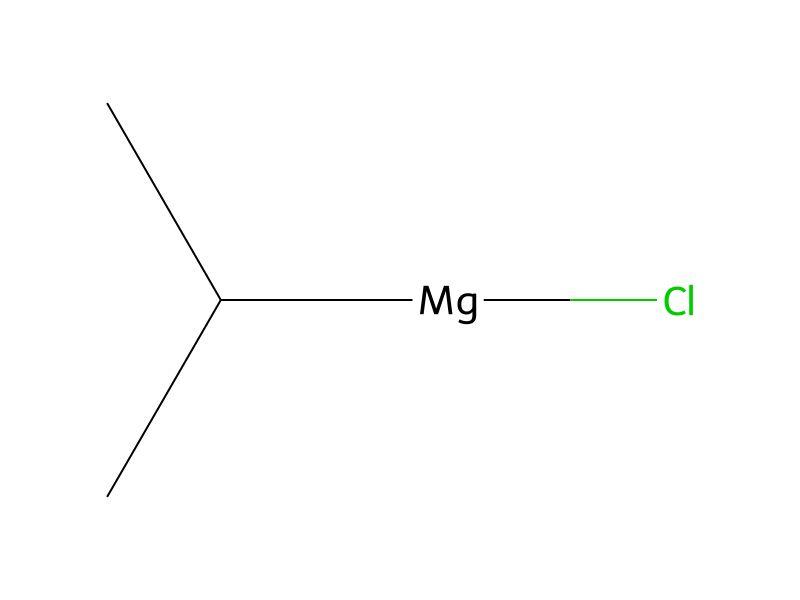
[Cl:1][C:2]1[CH:7]=[CH:6][C:5]([CH2:8][CH3:9])=[C:4](I)[CH:3]=1.C([Mg]Cl)(C)C.[B:16](OC)([O:19]C)[O:17]C.Cl.[Cl-].[Na+]>O1CCCC1.C(OCC)(=O)C>[Cl:1][C:2]1[CH:7]=[CH:6][C:5]([CH2:8][CH3:9])=[C:4]([B:16]([OH:19])[OH:17])[CH:3]=1Participants
8
Reactant 5




Product 1

Reagents, catalysts & solvents 2


Conditions
- Temperature
- -30 °C
Procedure
To a solution of 4-chloro-1-ethyl-2-iodo-benzene (5 g, 18.8 mmol) in anhydrous tetrahydrofuran (40 ml), cooled to −30° C., was added isopropyl magnesium chloride (2 M in tetrahydrofuran, 10 ml, 20 mmol) dropwise. After stirring at −30° C. for 30 minutes, trimethyl borate (4.2 ml, 38 mmol) was added dropwise and the mixture was stirred for 1.5 hours. The mixture was treated with hydrochloric acid (1 M, 25 ml), ethyl acetate (100 ml), and saturated aqueous sodium chloride solution (100 ml). The organic layer was dried over sodium sulfate and concentrated under reduced pressure. The residue was treated with hexane (50 ml) and the solid was filtered to afford 5-chloro-2-ethyl-phenyl boronic acid (1.8 g, 52% yield) as a white powder.
Workup
- stirringthe mixture was stirred for 1.5 hours
- dry with materialThe organic layer was dried over sodium sulfate
- concentrationconcentrated under reduced pressure
- additionThe residue was treated with hexane (50 ml)
- filtrationthe solid was filtered
Sources & evidence
- ORD record
- ord-58efa064964f4c97b743fc15c07741f1
- Source dataset
- uspto-grants-2008_09
- Patent number
- US07419984B2
Reaction notes
Loading…