Benzoyl chloride → Methyl 4-(2-benzenecarbonylamino-ethoxy)benzoate
Reaction equation
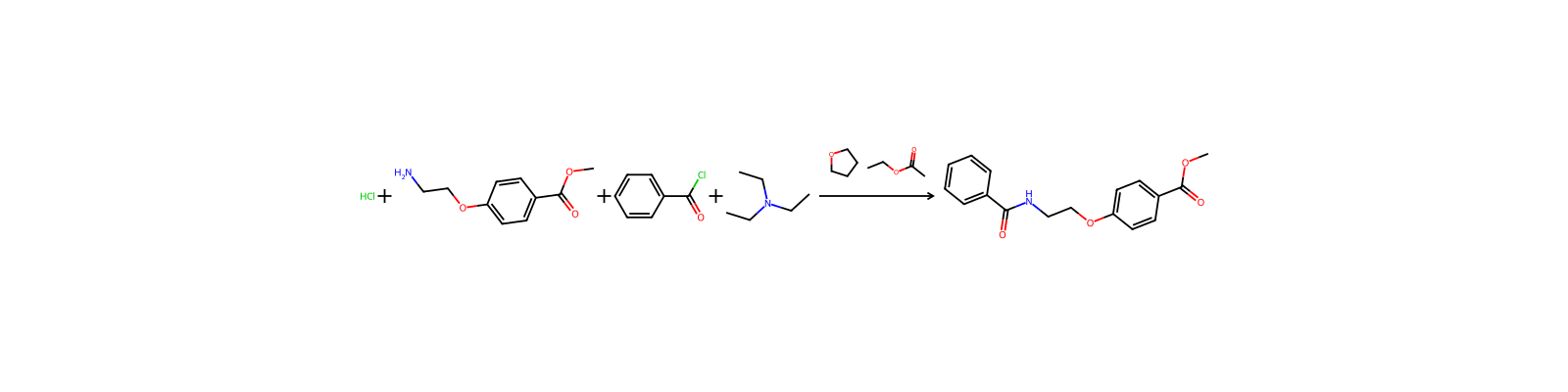
Cl.[NH2:2][CH2:3][CH2:4][O:5][C:6]1[CH:15]=[CH:14][C:9]([C:10]([O:12][CH3:13])=[O:11])=[CH:8][CH:7]=1.[C:16](Cl)(=[O:23])[C:17]1[CH:22]=[CH:21][CH:20]=[CH:19][CH:18]=1.C(N(CC)CC)C>C1COCC1.C(OCC)(=O)C>[C:17]1([C:16]([NH:2][CH2:3][CH2:4][O:5][C:6]2[CH:15]=[CH:14][C:9]([C:10]([O:12][CH3:13])=[O:11])=[CH:8][CH:7]=2)=[O:23])[CH:22]=[CH:21][CH:20]=[CH:19][CH:18]=1Participants
6






Procedure
To a suspension of methyl 4-(2-amino-ethoxy)benzoate hydrochloride (0.232 g, 1 mmol) in THF (6 ml) was added benzoyl chloride (0.140 g, 1 mmol) followed by triethylamine (0.121 g, 1.2 mmol). The reaction mixture was stirred for 1 h and then diluted with ethyl acetate. The organic layer was washed with 0.5 M aqueous HCl, saturated sodium bicarbonate solution, and brine. The organic layer was concentrated in vacuo to give methyl 4-(2-benzenecarbonylamino-ethoxy)benzoate which was directly used in the next step.
Workup
- washThe organic layer was washed with 0.5 M aqueous HCl, saturated sodium bicarbonate solution, and brine
- concentrationThe organic layer was concentrated in vacuo
Sources & evidence
- ORD record
- ord-f7e74a8e7fba43faafa0ea478990918e
- Source dataset
- uspto-grants-2008_09
- Patent number
- US07420089B2
Reaction notes
Loading…