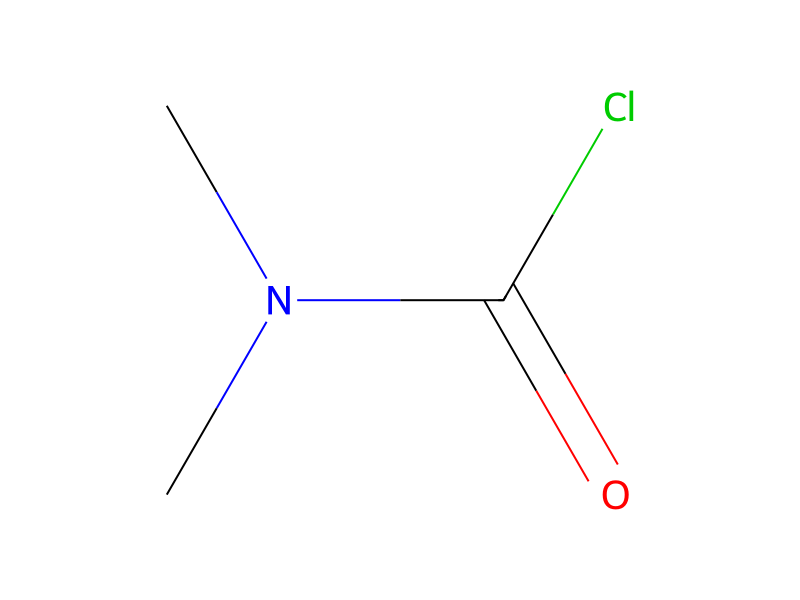
Dimethylcarbamoyl Chloride → HCID 21444460, compound
Reaction equation

[H-].[Na+].O1CCCC1.[CH3:8][C:9]1[CH:10]=[C:11]([OH:23])[CH:12]=[C:13]([CH3:22])[C:14]=1[S:15][C:16]1[CH:21]=[CH:20][CH:19]=[CH:18][N:17]=1.[CH3:24][N:25]([CH3:29])[C:26](Cl)=[O:27]>O>[CH3:24][N:25]([CH3:29])[C:26](=[O:27])[O:23][C:11]1[CH:12]=[C:13]([CH3:22])[C:14]([S:15][C:16]2[CH:21]=[CH:20][CH:19]=[CH:18][N:17]=2)=[C:9]([CH3:8])[CH:10]=1Participants
Reactant 4



Product 1

Reagents, catalysts & solvents 1

Procedure
To a stirred suspension of 240 mg. of sodium hydride in 20 ml. of dry tetrahydrofuran is added a solution of 2.31 g. of 3,5-dimethyl-4-(2-pyridylthio)phenol in 30 ml. of dry tetrahydrofuran. After the effervescence has subsided, a solution of 1.1 g. of N,N-dimethylcarbamoyl chloride in 10 ml. of dry tetrahydrofuran is added dropwise. The reaction mixture is stirred at ambient temperature for 16 hours, and then under reflux for 4 hours. The reaction mixture is cooled to room temperature, and then diluted with an excess of water. The product is extracted into ethyl acetate. The ethyl acetate is washed with water, dried using anhydrous magnesium sulfate, and then evaporated in vacuo to give crude 3,5-dimethyl-4-(2-pyridylthio)phenyl N,N-dimethylcarbamate. The crude product can be purified further by recrystallization.
Workup
- additionTo a stirred suspension of 240 mg
- temperatureunder reflux for 4 hours
- temperatureThe reaction mixture is cooled to room temperature
- extractionThe product is extracted into ethyl acetate
- washThe ethyl acetate is washed with water
- customdried
- customevaporated in vacuo
Sources & evidence
- ORD record
- ord-39913770e708484b8c8abff61f6646fd
- Source dataset
- uspto-grants-1977_04
- Patent number
- US04016278
Reaction notes
Loading…