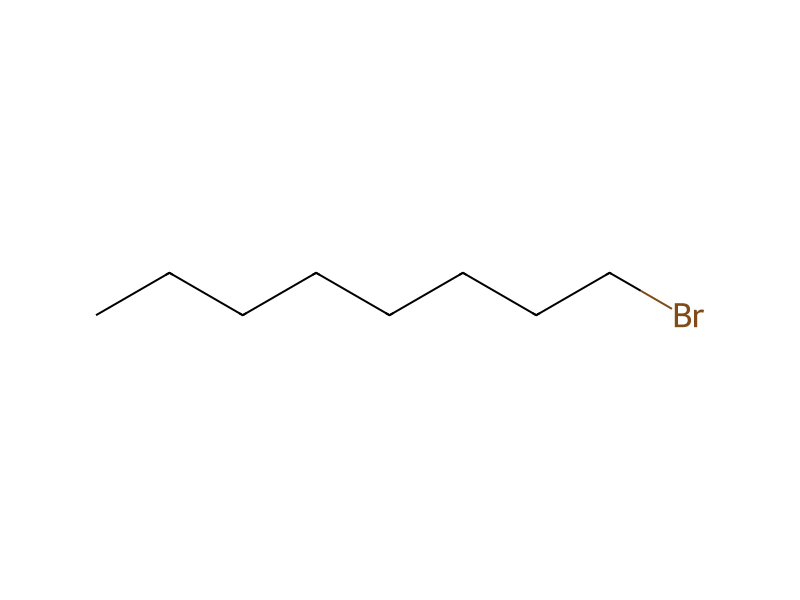
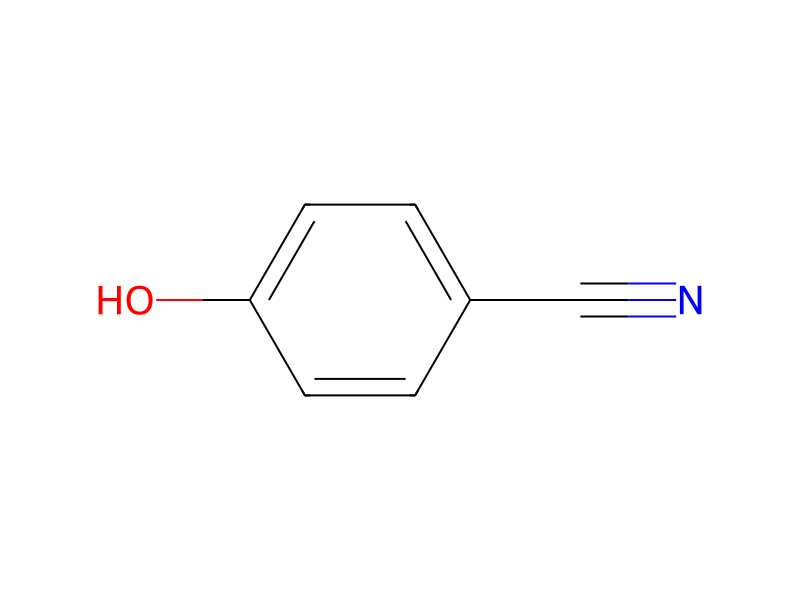
1-Bromooctane → 4-(Octyloxy)benzonitrile
Reaction equation

[OH:1][C:2]1[CH:9]=[CH:8][C:5]([C:6]#[N:7])=[CH:4][CH:3]=1.[CH2:10](Br)[CH2:11][CH2:12][CH2:13][CH2:14][CH2:15][CH2:16][CH3:17].C(=O)([O-])[O-].[K+].[K+]>CC(C)=O>[CH2:10]([O:1][C:2]1[CH:9]=[CH:8][C:5]([C:6]#[N:7])=[CH:4][CH:3]=1)[CH2:11][CH2:12][CH2:13][CH2:14][CH2:15][CH2:16][CH3:17]Participants
5
Reactant 3

Product 1

Reagents, catalysts & solvents 1

Procedure
In 4000 ml of acetone was dissolved 500 g (4.2 moles) of p-hydroxybenzonitrile and 965 g (5.0 moles) of octyl bromide, 828 g (6.0 moles) of anhydrous potassium carbonate was added thereto, and the mixture was refluxed with heating for 30 hours. Then, the inorganic salt was filtered off from the reaction mixture, acetone was distilled under reduced pressure. To the residue was added 2000 ml of ether and the mixture was washed with 2N aqueous solution of sodium hydroxide, water, then saturated aqueous solution of sodium chloride. The resulting organic layer was dried with anhydrous magnesium sulfate, and ether was distilled under reduced pressure to give 855 g of p-octyloxybenzonitrile (yield: 88%).
Workup
- additionwas added
- temperaturethe mixture was refluxed
- temperaturewith heating for 30 hours
- filtrationThen, the inorganic salt was filtered off from the reaction mixture, acetone
- distillationwas distilled under reduced pressure
- additionTo the residue was added 2000 ml of ether
- washthe mixture was washed with 2N aqueous solution of sodium hydroxide, water
- dry with materialThe resulting organic layer was dried with anhydrous magnesium sulfate, and ether
- distillationwas distilled under reduced pressure
Sources & evidence
- ORD record
- ord-838b0e67848640dc98e8615ae70919ee
- Source dataset
- uspto-grants-1991_10
- Patent number
- US05053507
Reaction notes
Loading…