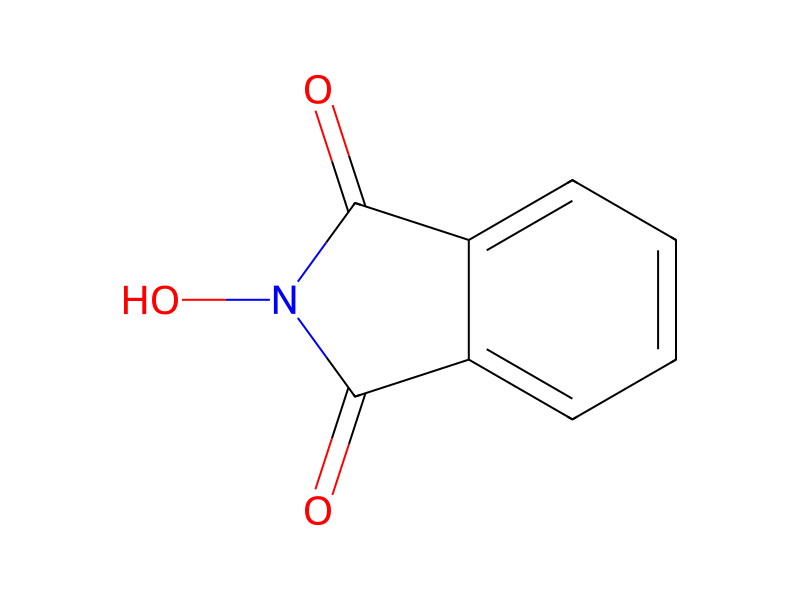
N-Hydroxyphthalimide → 5-Phthalimidooxymethyl-1,3-dioxane
Reaction equation

[OH:1][CH2:2][CH:3]1[CH2:8][O:7][CH2:6][O:5][CH2:4]1.O[N:10]1[C:14](=[O:15])[C:13]2=[CH:16][CH:17]=[CH:18][CH:19]=[C:12]2[C:11]1=[O:20].C1(P(C2C=CC=CC=2)C2C=CC=CC=2)C=CC=CC=1.N(C(OCC)=O)=NC(OCC)=O>O1CCCC1>[C:14]1(=[O:15])[N:10]([O:1][CH2:2][CH:3]2[CH2:8][O:7][CH2:6][O:5][CH2:4]2)[C:11](=[O:20])[C:12]2=[CH:19][CH:18]=[CH:17][CH:16]=[C:13]12Participants





Conditions
- Temperature
- 25 °C
Procedure
A mixture of 5-hydroxymethyl-1,3-dioxane (3.90 g, 33 mmol), N-hydroxyphthalimide (6.46 g, 39.6 mmol) and triphenylphosphine (10.39 g, 39.6 mmol) in tetrahydrofuran (150 ml) was cooled to O° C. and stirred during the addition of diethyl azodicarboxylate (6.24 ml, 39.6 mmol). The solution was then stirred for 16 h at 25° C. and evaporated to dryness. The residue was triturated twice with ether, evaporated to dryness then chromatographed in chloroform/methanol (40:1) to give 5-phthalimidooxymethyl-1,3-dioxane (6.63 g, 76.3%) as a white solid; m.p. 98-106° C.: νmax (KBr) 1780, 1735, 1470, 1400, 1160 cm-1 ; δH (CDCl3) 2.20(1H, m, CH), 4.07(4H, m, OCH2CHCH2O), 4.37(2H, d, J6.88 Hz, CH2ON), 4.86(2H, m, OCH2O), 7.8I(4H, m, C6H4); Found: C,59.31; H, 5.03; N, 5.31%; C13H13NO5 requires: C, 59.31; H, 4.98; N, 5.32%; m/z 264(MH+, 100%).
Workup
- temperaturewas cooled to O° C
- customevaporated to dryness
- customThe residue was triturated twice with ether
- customevaporated to dryness
- customthen chromatographed in chloroform/methanol (40:1)
Sources & evidence
- ORD record
- ord-4e9a2fd415c54960b20d35b19547ae05
- Source dataset
- uspto-grants-1991_10
- Patent number
- US05055458
Reaction notes
Loading…