Trifluoroacetic acid → HCID 11478106, compound
Reaction equation

C(O[C:6](=[O:26])[NH:7][C@H:8]([CH2:15][N:16]1[C:24]2[C:19](=[CH:20][C:21]([F:25])=[CH:22][CH:23]=2)[CH2:18][CH2:17]1)[CH2:9][CH2:10][S:11]([CH3:14])(=[O:13])=[O:12])(C)(C)C.C(O[C:32](=O)[NH:33][C@H:34](C(=O)N[C@H](CN1C2C(=CC(F)=CC=2)CC1)CCS(C)(=O)=O)[CH2:35][C:36]([CH3:39])([CH3:38])[CH3:37])(C)(C)C.F[C:63](F)(F)[C:64]([OH:66])=O.CN(C(O[N:77]1N=N[C:79]2[CH:80]=[CH:81]C=N[C:78]1=2)=[N+](C)C)C.F[P-](F)(F)(F)(F)F.C(N(C(C)C)CC)(C)C.C(=O)(O)[O-].[Na+]>ClCCl.O>[F:25][C:21]1[CH:20]=[C:19]2[C:24](=[CH:23][CH:22]=1)[N:16]([CH2:15][C@@H:8]([NH:7][C:6](=[O:26])[C@@H:34]([NH:33][C:32]1[O:66][C:64]3[CH:63]=[CH:81][CH:80]=[CH:79][C:78]=3[N:77]=1)[CH2:35][C:36]([CH3:37])([CH3:38])[CH3:39])[CH2:9][CH2:10][S:11]([CH3:14])(=[O:12])=[O:13])[CH2:17][CH2:18]2Participants
Reactant 6



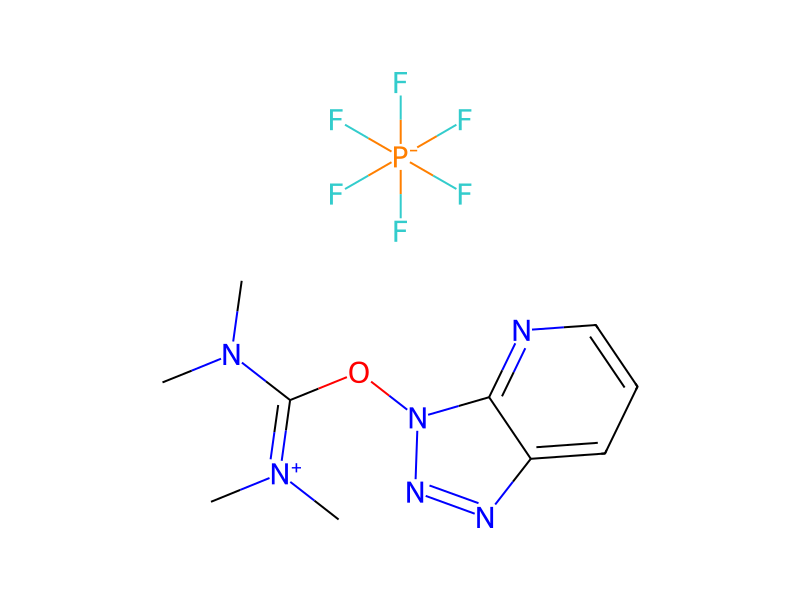


Product 1

Reagents, catalysts & solvents 2


Procedure
(S)-[1-(5-Fluoro-2,3-dihydro-indol-1-ylmethyl)-3-methanesulfonyl-propyl]-carbamic acid tert-butyl ester. This material was prepared in 72% yield in an analogous manner to Example 12: 1H NMR (CD3OD, 400 MHz) δ 1.56 (s, 9H), 2.01–2.16 (m, 1H), 2.32–2.43 (m, 1H), 3.06 (s, 3H), 3.07 (dd, 2H, J1=J2=4.0), 3.13–3.23(m, 2H), 3.23–3.34 (m, 2H), 3.95–4.06 (m, 1H), 4.70–4.79 (m, 1H), 6.48 (dd, 1H, J1=4.1, J2=8.5), 6.84–6.92 (m, 1H), 6.93–6.97 (m, 1H); HPLC-MS calcd. for C18H27FN2O4S (M+H+) 387.2. found 387.4. Step B. {1-(S)-[1-(S)-(5-Fluoro-2,3-dihydro-indol-1-ylmethyl)-3-methanesulfonyl-propylcarbamoyl]-3,3-dimethyl-butyl}-carbamic acid tert-butyl ester. The intermediate from Step A (500 mg, 1.29 mmol) was treated with 2 mL of a solution containing 45% trifluoroacetic acid, 45% dichloromethane and 10% water. The material was allowed to stand overnight and the solvent was removed. The resulting oil was treated with Boc-(L)-tBu-Ala (350 mg, 1.42 mmol), HATU (540 mg, 1.42 mmol) and dichloromethane (5 mL). The resulting suspension was treated with diisopropylethylamine (836 mg, 6.47 mmol) and allowed to stir overnight. The reaction contents were then poured into a separatory funnel and treated with saturated aqueous sodium bicarbonate solution. The aqueous layer was extracted with dichloromethane a total of 2 times and discarded. The comined organics were dried over MgSO4 and the solvent was removed. The residue was purified by automated silica gel chromatography using a linear gradient of 0 to 100% ethyl acetate in hexane to afford the title compound as a solid (506 mg, 76%): 1H NMR (CDCl3, 400 MHz) δ 0.74 (s, 9H), 1.41 (dd, 1H, J1=8.3, J2=14.5), 1.70 (dd, 1H, J1=4.4, J2=14.5), 2.57–2.72 (m, 2H), 2.85 (dd, 1H, J1=6.8, J2=13.6), 3.02 (dd, 1H, J1=7.7, J2=13.6), 3.07 (dd, 1H, J1=8.7, J2=17.4), 3.17–3.26 (m, 1H), 3.48 (dd, 1H, J1=4.5, J2=11.4), 3.55 (dd, 1H, J1=3.4, J2=11.4), 3.60 (s, 3H), 3.88–3.98 (m, 1H), 4.43 (ddd, 1H, J1=4.3, J2=8.1, J3=12.3), 6.16 (dd, 1H, J1=4.1, J2=8.5), 6.41 (d, 1H, J1=7.7), 6.48 (ddd, 1H, J1=2.6, J2=J3=9.0), 6.52–6.56 (m, 1H), 6.75–6.79 (m, 1H), 6.78–6.84 (m, 1H), 6.98–7.10 (m, 3H); HPLC-MS calcd. for C25H40FN3O5S (M+H+) 514.3. found 514.5. Step C. 2-(S)-(Benzooxazol-2-ylamino)-4,4-dimethyl-pentanoic acid [1-(S)-(5-fluoro-2,3-dihydro-indol-1-ylmethyl)-3-methanesulfonyl-propyl]-amide. The intermediate from step B (80 mg, 156 μmol) was treated with 2 mL of a solution containing 45% trifluoroacetic acid, 45% dichloromethane and 10% water. The material was allowed to stand overnight and the solvent was removed. The resulting material was partitioned between dichloromethane and 1 M NaOH. The organic phase was collected and the aqueous phase was extracted one more time with dichloromethane and discared. The combined organics were dried over MgSO4 and the solvent was removed. The resulting oil was treated with 2-chlorobenzoxazole (58 mg, 379 μmol), diisopropylethylamine (74 mg, 570 μmol) and n-butanol (2 mL). The reaction was then sealed and heated to 180° C. for 5 minutes using a microwave reactor. The reaction was almost over by HPLC-MS analysis but another 5 minute heating session was necessary. The reaction contents were then poured into a separatory funnel and treated with 5% aqueous sodium bisulfate solution. The aqueous layer was extracted with dichloromethane a total of 3 times and discarded. The comined organics were dried over MgSO4 and the solvent was removed. The residue was purified by automated silica gel chromatography using a linear gradient of 0 to 100% ethyl acetate in hexane to afford the title compound as a solid (37.7 mg, 46%): 1H NMR (CDCl3, 400 MHz) δ 0.88 (s, 9H), 1.61 (dd, 1H, J1=9.0, J2=14.6), 1.84 (dd, 1H, J1=3.4, J2=14.6), 1.89–2.02 (m, 1H), 2.11–2.22 (m, 2H), 2.46 (s, 3H), 2.73–2.87 (m, 2H), 2.86–3.05 (m, 3H), 3.11 (dd, 1H, J1=6.2, J2=13.9), 3.21–3.38 (m, 2H), 4.11–4.22 (m, 1H), 4.18–4.28 (m, 1H), 6.27 (dd, 1H, J1=4.1, J2=8.5), 6.42–6.53 (m, 1H), 6.57 (ddd, 1H, J1=2.5, J2=9.0, J3=11.3), 6.69 (dd, 1H, J1=2.4, J2=8.2), 6.90 (d, 1H, J1=8.6), 6.94–6.99 (m, 1H), 7.07–7.13 (m, 1H), 7.14 (d, 1H, J1=8.0), 7.29 (d, 1H, J1=7.7); HPLC-MS calcd. for C27H35FN4O4S (M+H+) 531.3. found 531.5.
Workup
- customThis material was prepared in 72% yield in an analogous manner to Example 12
- customthe solvent was removed
- customThe reaction contents
- additionwere then poured into a separatory funnel
- extractionThe aqueous layer was extracted with dichloromethane a total of 2 times
- dry with materialThe comined organics were dried over MgSO4
- customthe solvent was removed
- customThe residue was purified by automated silica gel chromatography
Sources & evidence
- ORD record
- ord-57ef33dc32d2452990857d3ab1b78262
- Source dataset
- uspto-grants-2007_02
- Patent number
- US07173051B2
Reaction notes
Loading…