Triphenylphosphine → HCID 22711630, compound
Reaction equation

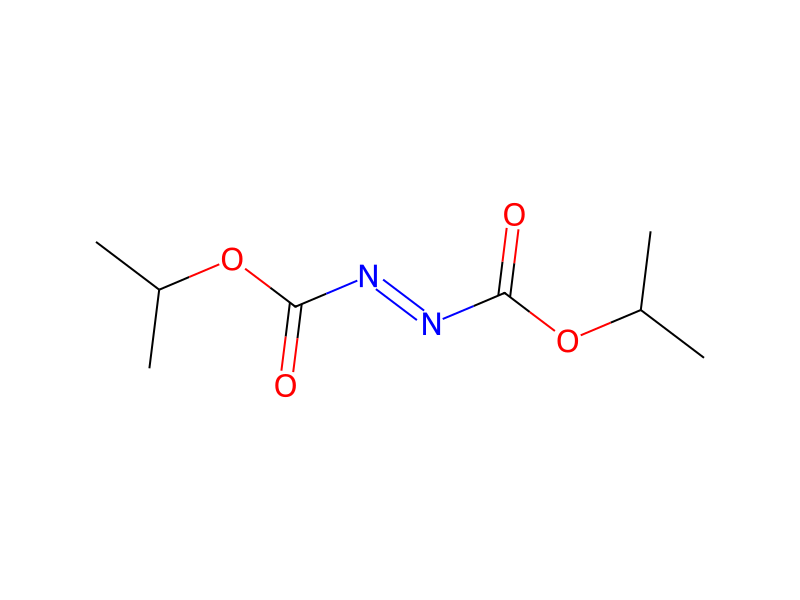
O[CH2:2][CH2:3][N:4]([CH2:19][C:20]1[CH:25]=[CH:24][CH:23]=[CH:22][CH:21]=1)[S:5]([C:8]1[CH:13]=[CH:12][C:11]([O:14][CH2:15][CH2:16][CH2:17][CH3:18])=[CH:10][CH:9]=1)(=[O:7])=[O:6].C1(P(C2C=CC=CC=2)C2C=CC=CC=2)C=CC=CC=1.CC(OC(/N=N/C(OC(C)C)=O)=O)C.[S:59]1C=CC=C1CC(O)=O>C1COCC1>[SH:59][CH2:2][CH2:3][N:4]([CH2:19][C:20]1[CH:25]=[CH:24][CH:23]=[CH:22][CH:21]=1)[S:5]([C:8]1[CH:13]=[CH:12][C:11]([O:14][CH2:15][CH2:16][CH2:17][CH3:18])=[CH:10][CH:9]=1)(=[O:7])=[O:6]Participants
6





Procedure
Part B: To a solution of 3.0 g (8.2 mmol) of N-(2-hydroxyethyl)-N-(phenylmethyl)-4-(n-butoxy)benzenesulfonamide from Part A and 2.38 g (9.1 mmol) of triphenylphosphine in 40 mL of anhydrous THF at 0 C, was added 1.4 mL (9.1 mmol) of diisopropylazodicarboxylate, followed by 0.65 mL (9.1 mmol) of thiolacetic acid. After stirring at room temperature for 15 hours, the reaction was concentrated and the residue chromatographed on 150 g of silica gel using 20-50% ethyl acetate/hexane to afford 2.4 g of the desired product, which was recrystallized from ethyl acetate/hexane to afford 1.7 g of pure product, m/e=428 (M+Li).
Workup
- concentrationthe reaction was concentrated
- customthe residue chromatographed on 150 g of silica gel using 20-50% ethyl acetate/hexane
Sources & evidence
- ORD record
- ord-a8c3e32fd421448b8388621975eacb4a
- Source dataset
- uspto-grants-2004_06
- Patent number
- US06747027B1
Reaction notes
Loading…