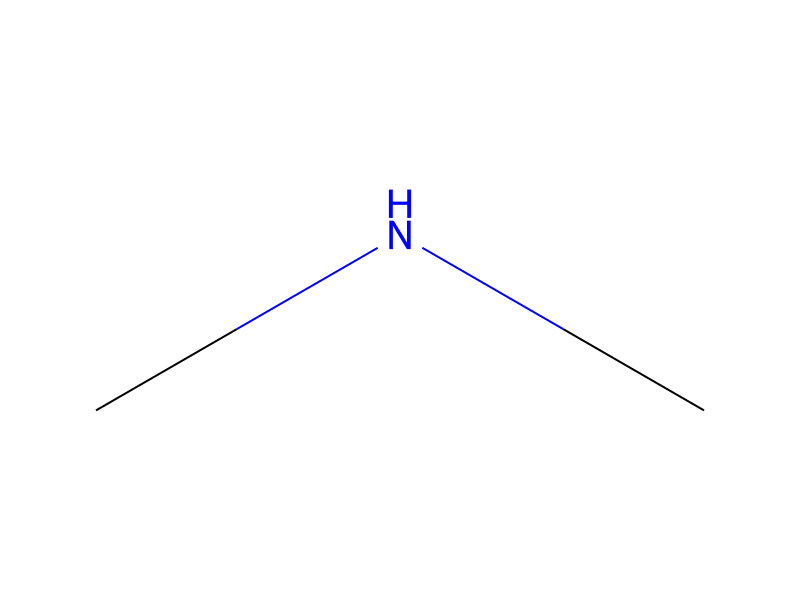
Dimethylamine → (3-(Dimethylamino)propyl)triphenylphosphonium bromide hydrobromide
Reaction equation

[C:1]1([P:7]([C:14]2[CH:19]=[CH:18][CH:17]=[CH:16][CH:15]=2)[C:8]2[CH:13]=[CH:12][CH:11]=[CH:10][CH:9]=2)[CH:6]=[CH:5][CH:4]=[CH:3][CH:2]=1.[Br:20][CH2:21][CH2:22][CH2:23]Br.[CH3:25][NH:26][CH3:27]>C1(C)C(C)=CC=CC=1.C(O)C>[BrH:20].[Br-:20].[CH3:25][N:26]([CH3:27])[CH2:21][CH2:22][CH2:23][P+:7]([C:1]1[CH:2]=[CH:3][CH:4]=[CH:5][CH:6]=1)([C:8]1[CH:13]=[CH:12][CH:11]=[CH:10][CH:9]=1)[C:14]1[CH:15]=[CH:16][CH:17]=[CH:18][CH:19]=1Participants
6





Conditions
- Temperature
- 130 °C
Procedure
There is prepared from 50 g triphenylphosphine and 38.5 g 1,3-dibrompropane in 150 ml xylene by heating for 20 hours at 130° C. under nitrogen 80 g crystalline (3-bromopropyl)-triphenylphosphoniumbromide with a melting point of 226° C. This is stirred using a solution of 33 g (0.7M) dimethylamine in 200 ml ethanol for 20 hours at 20°-25° C.) The residue is absorbed after removal of ethanol in a vacuum in 2-propanol and precipitated using hydrogen bromide gas. After recrystallization from ethanol, 43 g (3-dimethylaminopropyl)-triphenylphosphoniumbromide HBr is obtained with a melting point of 279° C.
Workup
- customfor 20 hours
- customat 20°-25° C.
- customis absorbed
- customafter removal of ethanol in a vacuum in 2-propanol
- customprecipitated
- customAfter recrystallization from ethanol
Sources & evidence
- ORD record
- ord-02e4379f61404698b03087532058352e
- Source dataset
- uspto-grants-1986_08
- Patent number
- US04605673
Reaction notes
Loading…