Hydrochloric Acid → 6-(2-Chlorobenzoyl)-5-(2-chlorobenzoylamino)indan
Reaction equation
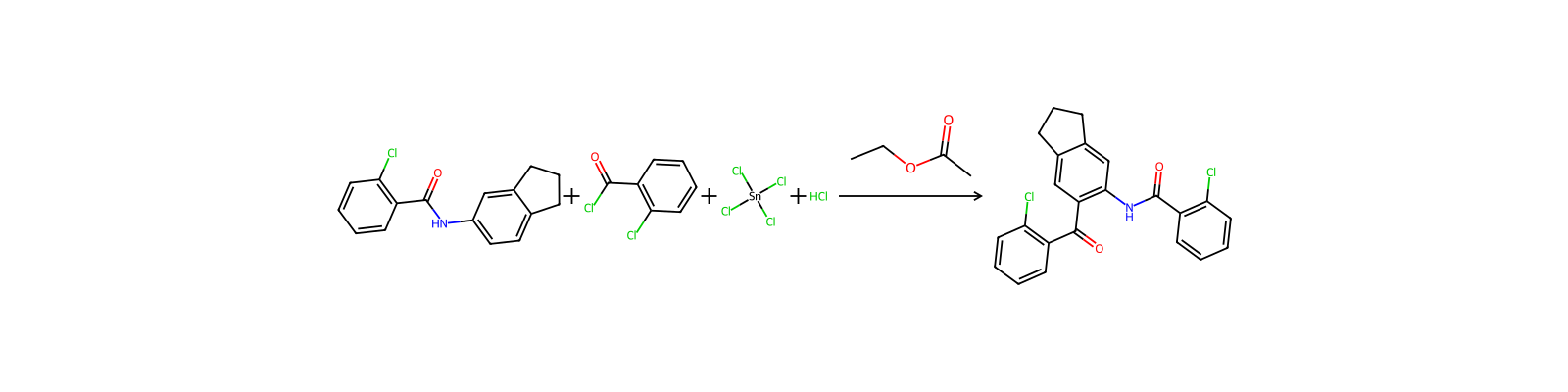
[Cl:1][C:2]1[CH:19]=[CH:18][CH:17]=[CH:16][C:3]=1[C:4]([NH:6][C:7]1[CH:8]=[C:9]2[C:13](=[CH:14][CH:15]=1)[CH2:12][CH2:11][CH2:10]2)=[O:5].[Cl:20][C:21]1[CH:29]=[CH:28][CH:27]=[CH:26][C:22]=1[C:23](Cl)=[O:24].[Sn](Cl)(Cl)(Cl)Cl.Cl>C(OCC)(=O)C>[Cl:20][C:21]1[CH:29]=[CH:28][CH:27]=[CH:26][C:22]=1[C:23]([C:15]1[CH:14]=[C:13]2[C:9]([CH2:10][CH2:11][CH2:12]2)=[CH:8][C:7]=1[NH:6][C:4](=[O:5])[C:3]1[CH:16]=[CH:17][CH:18]=[CH:19][C:2]=1[Cl:1])=[O:24]Participants
6




Conditions
- Temperature
- 130 °C
Procedure
A mixture of 5-(2-chlorobenzoylamino)indan (16 g), 2-chlorobenzoyl chloride (15.5 g) and tin tetrachloride (10.2 ml) was heated at 130° C. for 30 minutes and, then, diluted with ethyl acetate (150 ml), followed by addition of 3N HCl (150 ml). The organic layer was separated and washed with water, 2N NaOH and water in the order mentioned and the solvent was distilled off. The residue was chromatographed on silica gel and eluted with hexane-acetone (4:1) to give 6-(2-chlorobenzoyl)-5-(2-chlorobenzoylamino)indan as oil (16.0 g, 66.2%).
Workup
- customThe organic layer was separated
- washwashed with water, 2N NaOH and water in the order
- distillationthe solvent was distilled off
- customThe residue was chromatographed on silica gel
- washeluted with hexane-acetone (4:1)
Sources & evidence
- ORD record
- ord-c3b85288842e4748a11fb74cde879943
- Source dataset
- uspto-grants-1995_05
- Patent number
- US05418239
Reaction notes
Loading…