4-Methylmorpholine → 2-(1-Pyrrolidinyl)carbonyl-1-benzylpyrrolidine
Reaction equation
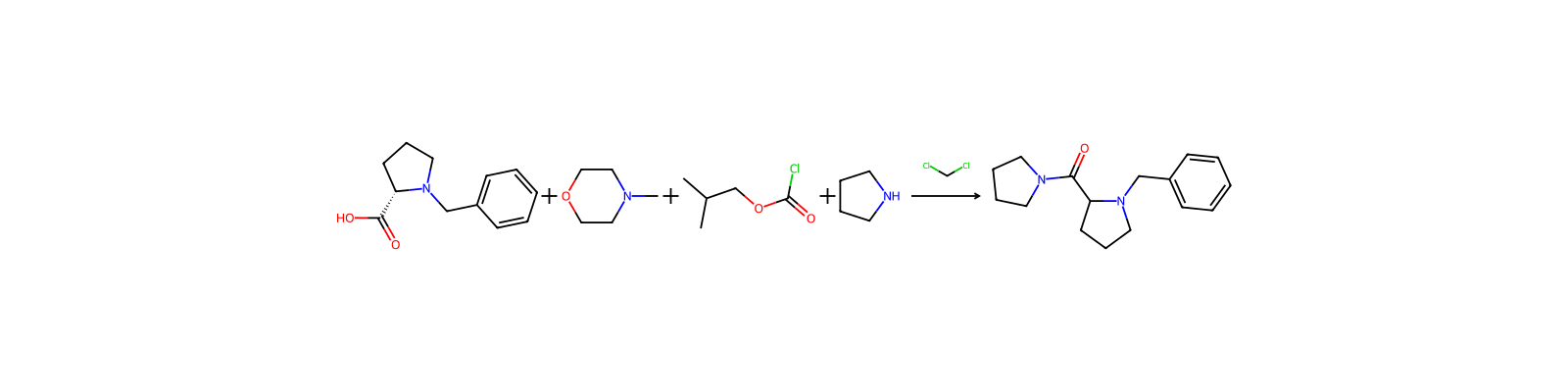
[CH2:1]([N:8]1[CH2:15][CH2:14][CH2:13][C@H:9]1[C:10]([OH:12])=O)[C:2]1[CH:7]=[CH:6][CH:5]=[CH:4][CH:3]=1.C[N:17]1[CH2:22][CH2:21]O[CH2:19][CH2:18]1.ClC(OCC(C)C)=O.N1CCCC1>ClCCl>[N:17]1([C:10]([CH:9]2[CH2:13][CH2:14][CH2:15][N:8]2[CH2:1][C:2]2[CH:3]=[CH:4][CH:5]=[CH:6][CH:7]=2)=[O:12])[CH2:22][CH2:21][CH2:19][CH2:18]1Participants
6





Procedure
A solution of 1-benzyl-L-proline (50 g) in dichloromethane (300 ml) is cooled with ice. To the solution is added N-methylmorpholine (22.5 g), and then further thereto is added dropwise isobutyl chloroformate (30 g). The mixture is stirred at the same temperature for about one hour, and thereto is added dropwise pyrrolidine (18.8 ml) at the same temperature. The mixture is warmed to room temperature, and stirred for two days. The mixture is washed twice with water (250 ml), and dried over magnesium sulfate. The mixture is concentrated under reduced pressure, and the residue is recrystallized from ethyl acetate-n-hexane to give 2-(1-pyrrolidinyl)carbonyl-1-benzylpyrrolidine (31 g), as white powder.
Workup
- stirringstirred for two days
- washThe mixture is washed twice with water (250 ml)
- dry with materialdried over magnesium sulfate
- concentrationThe mixture is concentrated under reduced pressure
- customthe residue is recrystallized from ethyl acetate-n-hexane
Sources & evidence
- ORD record
- ord-520efe8c1c574273821a2b313e60c990
- Source dataset
- uspto-grants-2000_10
- Patent number
- US06140330
Reaction notes
Loading…