Potassium Carbonate → 4-Bromotriphenylamine
Reaction equation

[Br:1][C:2]1[CH:7]=[CH:6][C:5](I)=[CH:4][CH:3]=1.[C:9]1([NH:15][C:16]2[CH:21]=[CH:20][CH:19]=[CH:18][CH:17]=2)[CH:14]=[CH:13][CH:12]=[CH:11][CH:10]=1.C(=O)([O-])[O-].[K+].[K+].C1OCCOCCOCCOCCOCCOC1.IC1C=CC=CC=1N(C1C=CC=CC=1)C1C=CC=CC=1>[Cu].ClC1C=CC=CC=1Cl>[CH:19]1[CH:20]=[CH:21][C:16]([N:15]([C:5]2[CH:6]=[CH:7][C:2]([Br:1])=[CH:3][CH:4]=2)[C:9]2[CH:14]=[CH:13][CH:12]=[CH:11][CH:10]=2)=[CH:17][CH:18]=1Participants
8

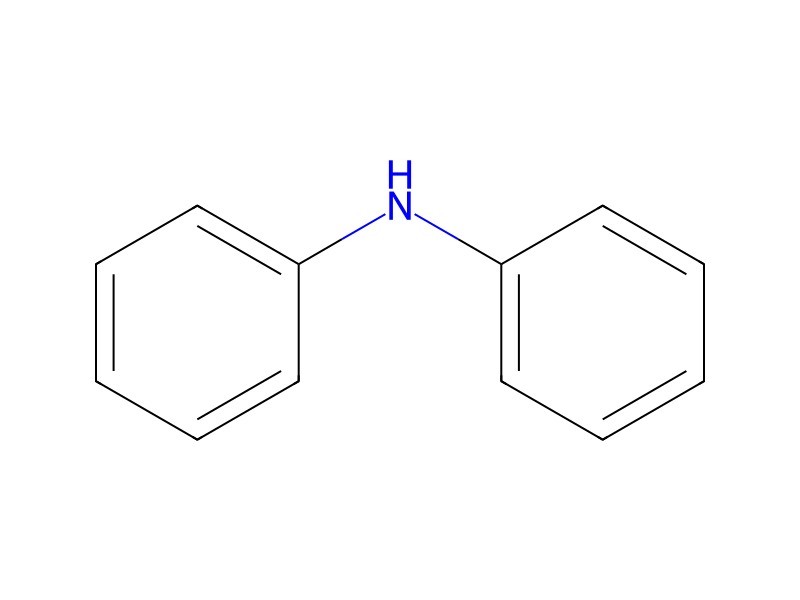




Procedure
A mixture of 1-bromo-4-iodobenzene (11.30 g., 40 mmol.), diphenylamine (6.65 g., 39.3 mmol.), powdered potassium carbonate (26.6 g., 192.7 mmol.), 18-crown-6 (1.06 g., 4 mmol.), copper bronze (1.37 g., 21.6 mmol.), and 1.2-dichlorobenzene (40 ml) was kept at 190° C., cooled and filtered. The residue left on concentration of filtrate, was chromatograhped on silica gel. After elution with hexanes (1 liter), the product came out in 9:1 toluene hexanes eluates, and was isolated as a colorless solid after trituration with methanol, 4.47 g. (35% yield), m.p. 113-115° C. Mass Spec (m/z): 371 (M+iodotriphenylamine), 323 325 (M+).
Workup
- customwas kept at 190° C.
- temperaturecooled
- filtrationfiltered
- waitThe residue left on concentration of filtrate
- washAfter elution with hexanes (1 liter)
- customwas isolated as a colorless solid after trituration with methanol, 4.47 g
Sources & evidence
- ORD record
- ord-2a038f16cb4c4835ac905f8500799ebc
- Source dataset
- uspto-grants-2001_10
- Patent number
- US06300502B1
Reaction notes
Loading…