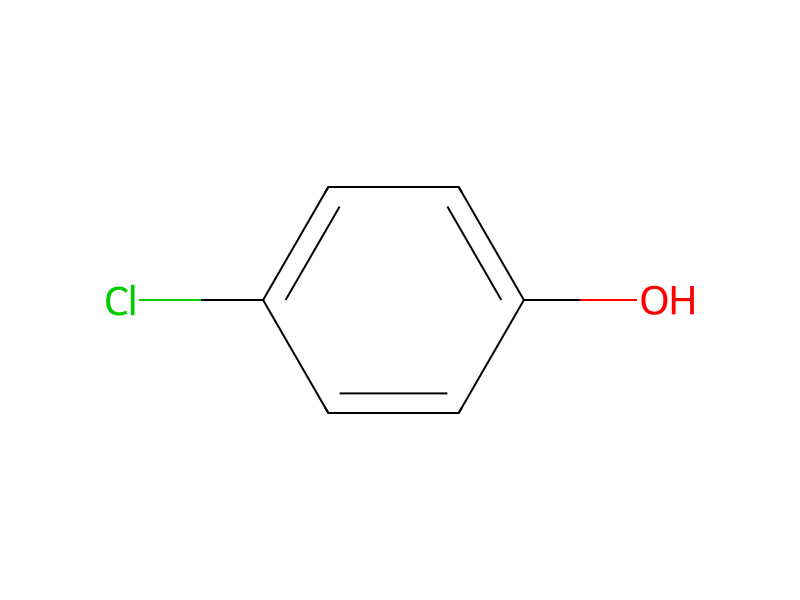
4-Chlorophenol → HCID 15482077, compound
Reaction equation

[H-].[Na+].Cl[C:4]1[C:5]2[CH:14]=[C:13]3[O:15][CH2:16][O:17][C:12]3=[CH:11][C:6]=2[S:7][C:8]=1[CH:9]=[O:10].[Cl:18][C:19]1[CH:24]=[CH:23][C:22]([OH:25])=[CH:21][CH:20]=1>CN(C)C=O>[Cl:18][C:19]1[CH:24]=[CH:23][C:22]([O:25][C:4]2[C:5]3[CH:14]=[C:13]4[O:15][CH2:16][O:17][C:12]4=[CH:11][C:6]=3[S:7][C:8]=2[CH:9]=[O:10])=[CH:21][CH:20]=1Participants
5
Reactant 3


Product 1

Reagents, catalysts & solvents 1

Procedure
1 equivalent of sodium hydride and then 0.094 mol of the product obtained in Step D are added at ambient temperature and under an inert atmosphere to a solution of 0.10 mol of 4-chlorophenol in 250 ml of dimethylformamide. After 12 hours' reaction at 80° C., the reaction mixture is concentrated under reduced pressure. The residue is then diluted with ethyl acetate, washed with water and then with an aqueous solution of NaOH and then of NaCl, dried over calcium sulphate, filtered and concentrated under reduced pressure. Chromatography over silica gel (dichloromethane/ethyl acetate: 98/2) allows the expected product to be isolated.
Workup
- customAfter 12 hours' reaction at 80° C.
- concentrationthe reaction mixture is concentrated under reduced pressure
- additionThe residue is then diluted with ethyl acetate
- washwashed with water
- dry with materialwith an aqueous solution of NaOH and then of NaCl, dried over calcium sulphate
- filtrationfiltered
- concentrationconcentrated under reduced pressure
- customto be isolated
Sources & evidence
- ORD record
- ord-45198605680e4fbd866bbf6b8ae69d1d
- Source dataset
- uspto-grants-2001_10
- Patent number
- US06302837B1
Reaction notes
Loading…