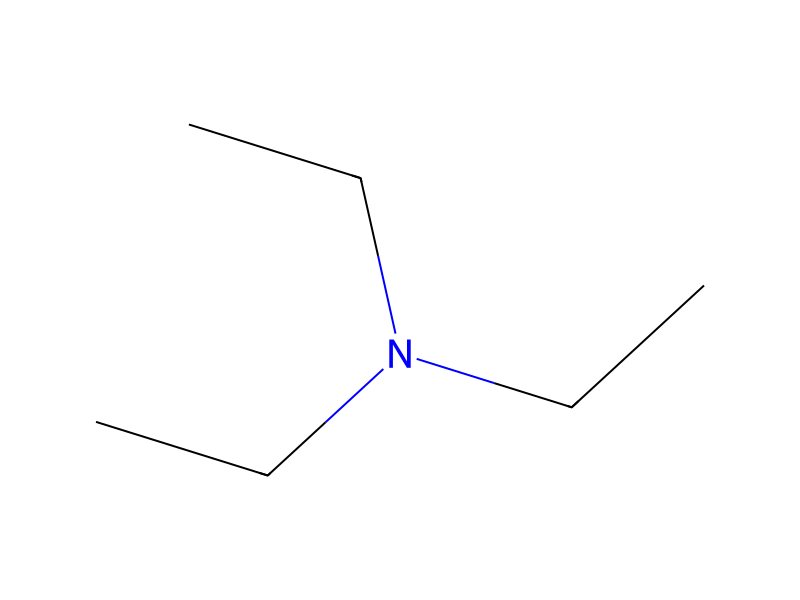
Triethylamine → 2-(4-chloro-2-fluoro-5-isopropyloxyphenyl)-6,7-dihydro-pyrrolo[1,2-c]pyrimidine-1,3(2H,5H)-dione
Reaction equation

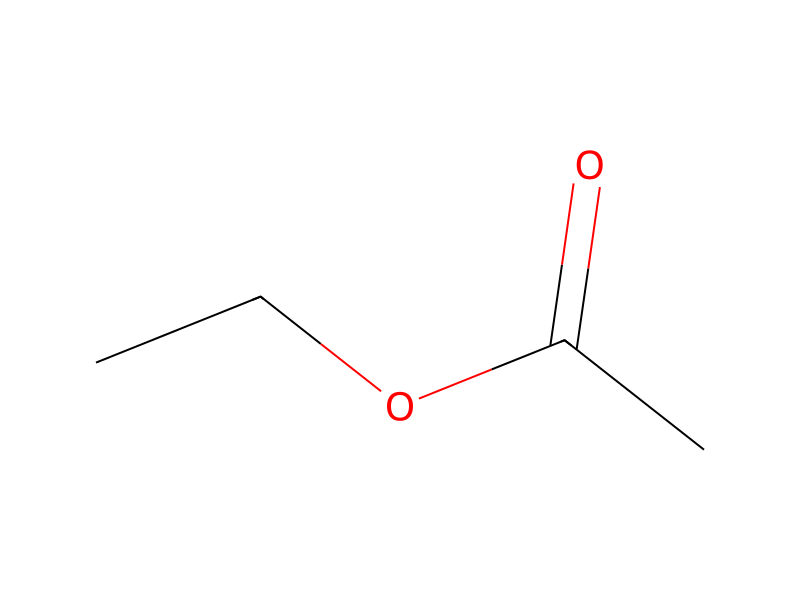
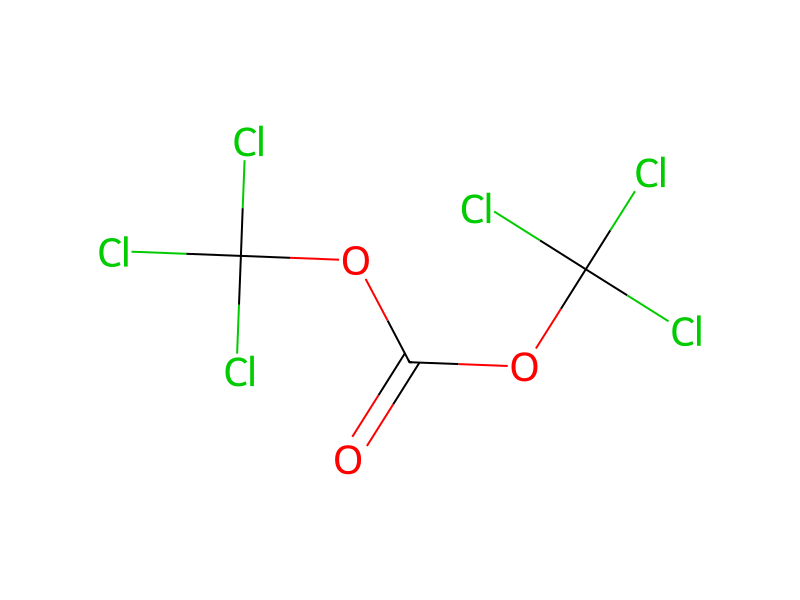
[Cl:1][C:2]1[C:8]([O:9][CH:10]([CH3:12])[CH3:11])=[CH:7][C:5]([NH2:6])=[C:4]([F:13])[CH:3]=1.C([N:16]([CH2:19][CH3:20])[CH2:17][CH3:18])C.ClC(Cl)(O[C:25](=[O:31])OC(Cl)(Cl)Cl)Cl.[C:33](OCC)(=[O:35])[CH3:34]>>[Cl:1][C:2]1[C:8]([O:9][CH:10]([CH3:11])[CH3:12])=[CH:7][C:5]([N:6]2[C:33](=[O:35])[CH:34]=[C:19]3[CH2:20][CH2:18][CH2:17][N:16]3[C:25]2=[O:31])=[C:4]([F:13])[CH:3]=1Participants


Procedure
4-Chloro-2-fluoro-5-isopropyloxyaniline (9.4 g) and triethylamine (9.4 g) in dry ethyl acetate (110 ml) was stirred at 0° C. and a solution of triphosgene (13.8 g) in ethyl acetate (110 ml) was added dropwise. The mixture was heated at reflux for 2 hours, cooled to room temperature, filtered, and the filtrate evaporated. The crude isocyanate was dissolved in N,N-dimethylformamide (70 ml) and added dropwise to a mixture of sodium hydride (1.2 g) and 2,2-dimethyl-5-(2-tetrahydropyrrolylidene)-1,3-dioxane-4,6-dione (9.9 g) in N,N-dimethylformamide (50 ml) stirred at −30° C. The mixture was stirred at room temperature for 0.5 hours and at 110° C. for 4 hours. The volume was reduced under reduced pressure and the residue processed. Column chromatography (silica gel, hexane:ethyl acetate, 2:3) yielded 2-(4-chloro-2-fluoro-5-isopropyloxyphenyl)-6,7-dihydro-pyrrolo[1,2-c]pyrimidine-1,3(2H,5H)-dione, (9.0 g, 60%) 1H NMR (CDCl3, TMS): 1.36(6H, d, J=6.1 Hz), 2.19(2H, m), 2.99(2H, t, J=7.9 Hz), 3.99(2H, m), 4.46(1H, m), 5.74(1H, s), 6.85(1H, d, J=6.6 Hz), 7.29(1H, d, J=6.6 Hz).
Workup
- temperatureThe mixture was heated
- temperatureat reflux for 2 hours
- filtrationfiltered
- customthe filtrate evaporated
- dissolutionThe crude isocyanate was dissolved in N,N-dimethylformamide (70 ml)
- additionadded dropwise to a mixture of sodium hydride (1.2 g) and 2,2-dimethyl-5-(2-tetrahydropyrrolylidene)-1,3-dioxane-4,6-dione (9.9 g) in N,N-dimethylformamide (50 ml)
- stirringThe mixture was stirred at room temperature for 0.5 hours and at 110° C. for 4 hours
Sources & evidence
- ORD record
- ord-de5ec48e033145b882cc71412deec177
- Source dataset
- uspto-grants-2001_10
- Patent number
- US06303543B1
Reaction notes
Loading…