Hydrochloric Acid → 2-(3-biphenylyl)ethanol
Reaction equation

Br[C:2]1[CH:3]=[C:4]([C:8]2[CH:13]=[CH:12][CH:11]=[CH:10][CH:9]=2)[CH:5]=[CH:6][CH:7]=1.C([Li])(C)(C)C.CCCCC.[CH2:24]1[O:26][CH2:25]1.Cl>C(OCC)C.O>[C:4]1([C:8]2[CH:13]=[CH:12][CH:11]=[CH:10][CH:9]=2)[CH:5]=[CH:6][CH:7]=[C:2]([CH2:24][CH2:25][OH:26])[CH:3]=1Participants







Conditions
- Temperature
- -78 °C
Procedure
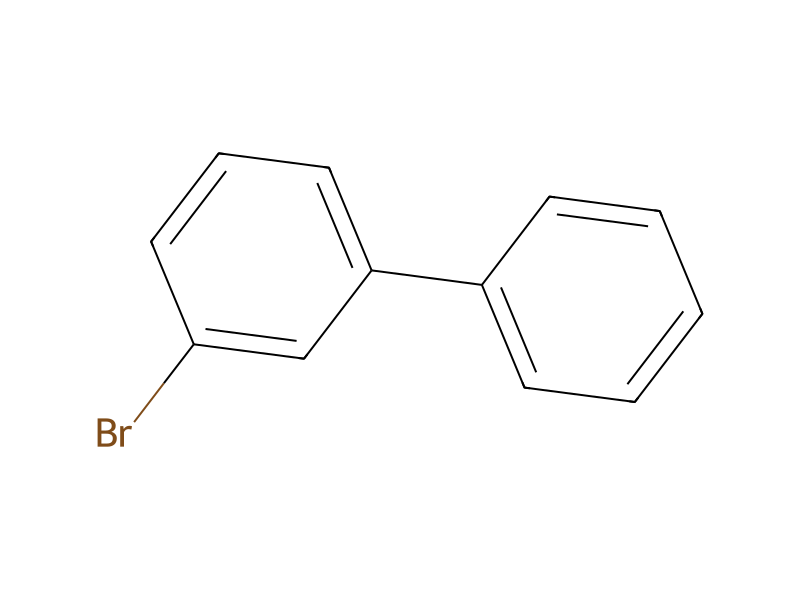
To a solution of 3-bromobiphenyl (18 g, 77 mmol) in diethyl ether (150 ml) under N2 cooled to −78° C. was added 1.6 M t-butyl lithium in pentane (100 ml, 0.16 mole) via cannula over a 15 minute period. The solution was stirred 30 minutes at −78° C., ethylene oxide (9 g, 0.2 mole added and the reaction mixture allowed to warm to room temperature over a 1 hour period. The solution was boiled briefly to drive off excess ethylene oxide, transferred to a separatory funnel, a small volume of water added, and neutralized with concentrated HCl. The organic solution was dried (MgSO4), concentrated in vacuo and the residue purified by chromatography on silica gel eluting with ethyl acetate:hexane (1:4) to give 2-(3-biphenylyl)ethanol (10.5 g). 1H NMR (CDCl3, 60 MHz) δ: 2.81 (t, J=7 Hz, 2H, CH2), 3.76 (t, J=7 Hz, 2H, CH2), 6.95-7.70 (m, 9H, Ar).
Workup
- temperatureto warm to room temperature over a 1 hour period
- customtransferred to a separatory funnel
- dry with materialThe organic solution was dried (MgSO4)
- concentrationconcentrated in vacuo
- customthe residue purified by chromatography on silica gel eluting with ethyl acetate:hexane (1:4)
Sources & evidence
- ORD record
- ord-99b32f10fd19416bb6e94e5f792b38c3
- Source dataset
- uspto-grants-2001_10
- Patent number
- US06306865B1
Reaction notes
Loading…