Hydroxyacetone → HCID 21934046, compound
Reaction equation

[F:1][C:2]1[CH:3]=[C:4]([N:9]2[C:14](=[O:15])[C:13]([OH:16])=[C:12]([C:17]3[CH:22]=[CH:21][C:20]([S:23]([CH3:26])(=[O:25])=[O:24])=[CH:19][CH:18]=3)[CH:11]=[N:10]2)[CH:5]=[CH:6][C:7]=1[F:8].C1C=CC(P(C2C=CC=CC=2)C2C=CC=CC=2)=CC=1.[CH3:46][C:47]([CH2:49]O)=[O:48].CC(OC(/N=N/C(OC(C)C)=O)=O)C>C1COCC1>[F:1][C:2]1[CH:3]=[C:4]([N:9]2[C:14](=[O:15])[C:13]([O:16][CH2:46][C:47](=[O:48])[CH3:49])=[C:12]([C:17]3[CH:22]=[CH:21][C:20]([S:23]([CH3:26])(=[O:25])=[O:24])=[CH:19][CH:18]=3)[CH:11]=[N:10]2)[CH:5]=[CH:6][C:7]=1[F:8]Participants


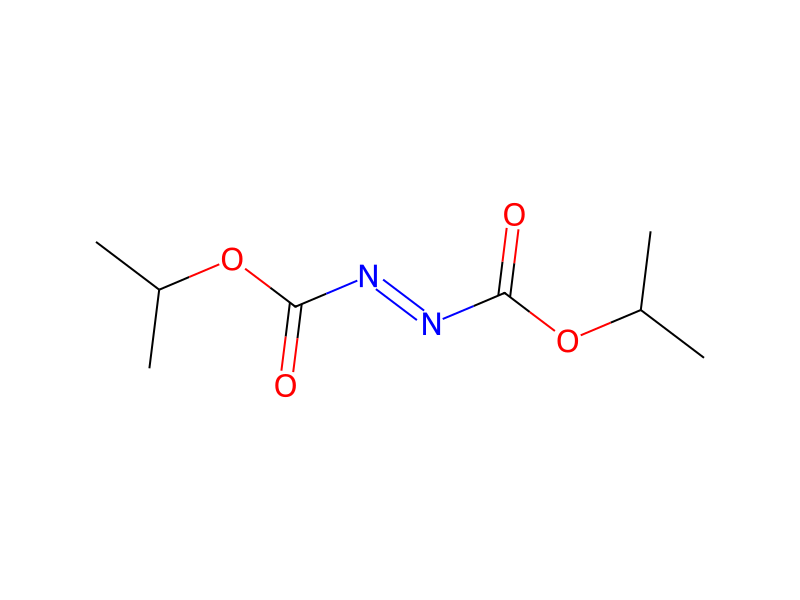



Procedure
A solution of 2-(3,4-difluorophenyl)-4-hydroxy-5-[4-(methylsulfonyl)phenyl]-3(2H)-pyridazinone (378 mg, 1 mmol), Ph3P (524 mg, 2 mmol) and acetol (74 mg, 1 mmol) in THF (25 mL) at room temperature was treated dropwise with a solution of DIAD (0.4 mL, 2 mmol) in THF (5 mL). The mixture was stirred at room temperature for 6 hours and concentrated in vacuo. The residue was chromatographed (silica gel, 1:1 hexanes-ethyl acetate) to provide the desired product (yield: 205 mg, 48%). mp 169-170° C.; 1H NMR (300 MHz, DMSO-d6) δ 2.08 (s, 3H), 3.30 (s, 3H), 5.30 (s, 2H), 7.48 (m, 1H), 7.62 (q, J=10 Hz, 1H), 7.75 (m, 1H), 7.94 (d, J=9 Hz, 2H), 8.05 (d, J=9 Hz, 2H), 8.21 (s, 1H); MS (APCI+) m/z 435 (M+H)+, (APCI−) m/z 469 (M+Cl)-; Anal. calc. for C20H16F2N2O5S.0.75H2O: C, 53.62; H, 3.93; N, 6.25. Found: C, 53.26; H, 3.61; N, 6.08.
Workup
- concentrationconcentrated in vacuo
- customThe residue was chromatographed (silica gel, 1:1 hexanes-ethyl acetate)
Sources & evidence
- ORD record
- ord-d7bc874c9bf8418e9d3ce40bf45fa204
- Source dataset
- uspto-grants-2001_10
- Patent number
- US06307047B1
Reaction notes
Loading…