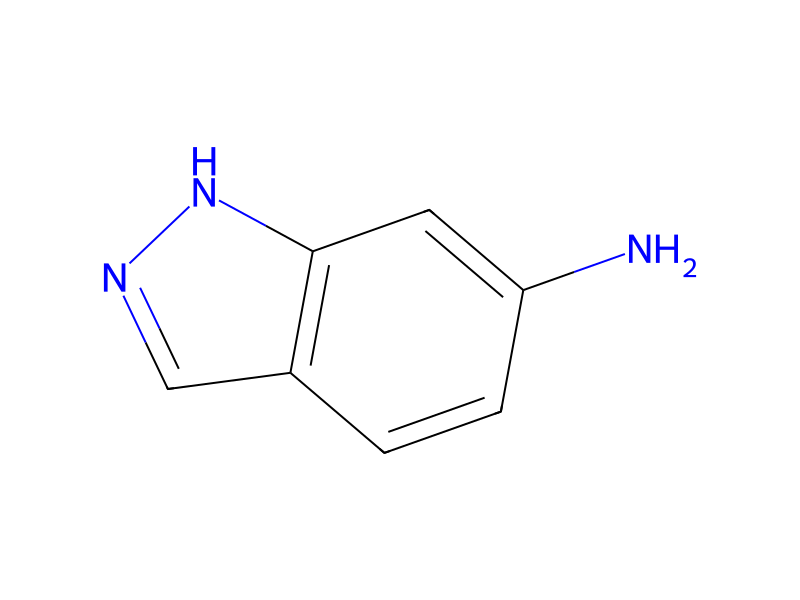
1H-Indazol-6-amine → HCID 22646658, compound
Reaction equation

[Cl:1][C:2]1[C:11]2[C:6](=[CH:7][C:8]([O:14][CH3:15])=[C:9]([O:12][CH3:13])[CH:10]=2)[N:5]=[CH:4][CH:3]=1.[NH2:16][C:17]1[CH:25]=[C:24]2[C:20]([CH:21]=[N:22][NH:23]2)=[CH:19][CH:18]=1>CN(C=O)C>[ClH:1].[CH3:13][O:12][C:9]1[CH:10]=[C:11]2[C:6](=[CH:7][C:8]=1[O:14][CH3:15])[N:5]=[CH:4][CH:3]=[C:2]2[NH:16][C:17]1[CH:25]=[C:24]2[C:20]([CH:21]=[N:22][NH:23]2)=[CH:19][CH:18]=1Participants
4
Reactant 2

Product 1

Reagents, catalysts & solvents 1

Conditions
- Temperature
- 140 °C
Procedure
A suspension of 4-chloro-6,7-dimethoxyquinoline (200 mg, 0.89 mmol), (prepared as described for the starting material in Example 2), and 6-aminoindazole (131 mg, 0.98 mmol) in DMF (2.5 ml) was heated at 140° C. for 1.5 hours. The solid was collected by filtration, washed with isopropanol and dried under vacuum to give 6,7-dimethoxy-4-(1H-indazol-6-ylamino)quinoline hydrochloride (171 mg, 54%).
Workup
- custom(prepared
- filtrationThe solid was collected by filtration
- washwashed with isopropanol
- customdried under vacuum
Sources & evidence
- ORD record
- ord-19b29c34a1104cfb9a27adf9813d90b5
- Source dataset
- uspto-grants-2004_10
- Patent number
- US06809097B1
Reaction notes
Loading…