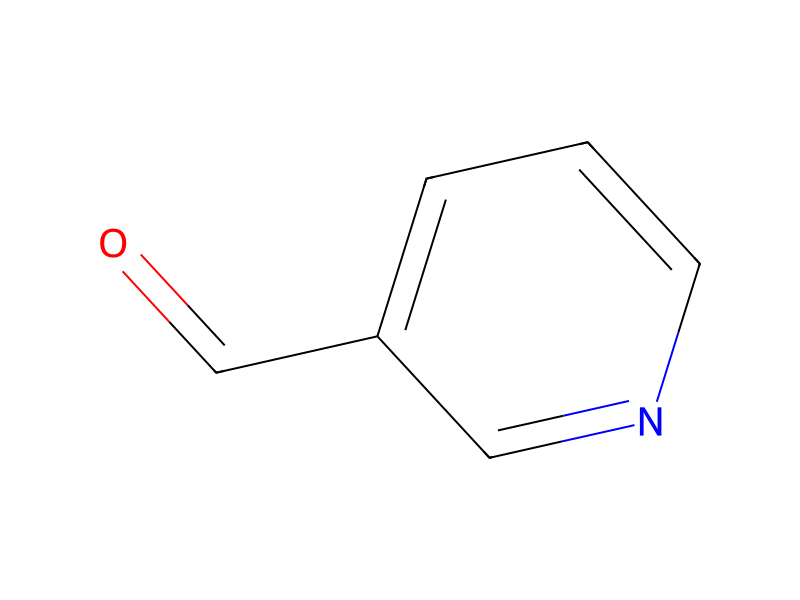
3-Pyridinecarboxaldehyde → HCID 65645406, compound
Reaction equation

[N:1]1[CH:6]=[CH:5][CH:4]=[C:3](C=O)[CH:2]=1.[Cl:9][C:10]1[C:14](C2C=NC=CC=2)=[N:13][S:12][N:11]=1.[H-].[Na+]>C1COCC1>[Cl:9][C:10]1[C:14]([C:6]2[CH:5]=[CH:4][CH:3]=[CH:2][N:1]=2)=[N:13][S:12][N:11]=1Participants
Reactant 3


Product 1

Reagents, catalysts & solvents 1

Procedure
3-(3-chloro-1,2,5-thiadiazol-4-yl-pyridine (compound 1) was synthesized from 3-pyridinecarboxaldehyde following, except with slight modification, from the published procedure as provided in Sauerberg et al, Journal Medicinal Chemistry, 1992, Vol. 35, Page 2274. 3-(3-Chloro-1,2,5-thiadiazol-4-yl)pyridine was reacted with a diol (compound 2, wherein n=6, 7, 8, 9, 10 or 12) in the presence of sodium hydride in refluxing THF to yield bis[3-(pyridin-3-yl)-1,2,5-thiadiazol-4-yl]alkyl-diethers (compound 3, wherein n=6, 7, 8, 9, 19 or 12) in 75-90% yield. These diethers were treated with excess methyl iodide in acetone or chloroform to give bis-quaternary ammonium iodides (compound 4, wherein n=6, 7, 8, 9, 10 or 12) in 96-100% yield. The quaternary salts were then treated with 5 equivalents of sodium borohydride in a mixture of methanol and chloroform to yield the compounds 5, wherein n=6, 7, 8, 9, 10 or 12 in 50-60% yield. Dry hydrogen chloride gas was then bubbled through the methanolic solution of compounds 5 at 0° C. to give compounds 6, wherein n=6, 7, 8, 9, 10 or 12 in 95-100% yield.
Workup
- customas provided in Sauerberg et al, Journal Medicinal Chemistry, 1992, Vol. 35, Page 2274
Sources & evidence
- ORD record
- ord-75dbc61f0df04e68b2db5c4f53bd6f85
- Source dataset
- uspto-grants-2003_08
- Patent number
- US06602891B2
Reaction notes
Loading…