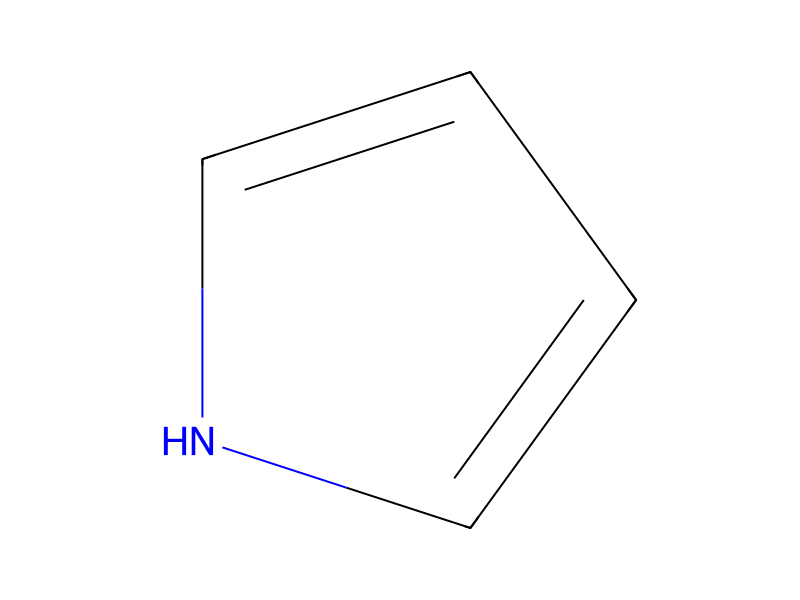
Pyrrole → N-Triisopropylsilylpyrrole
Reaction equation

[NH:1]1[CH:5]=[CH:4][CH:3]=[CH:2]1.C([Li])CCC.[CH:11]([Si:14](Cl)([CH:18]([CH3:20])[CH3:19])[CH:15]([CH3:17])[CH3:16])([CH3:13])[CH3:12]>C1COCC1.CCCCCC.C(OCC)C>[CH:11]([Si:14]([CH:18]([CH3:20])[CH3:19])([CH:15]([CH3:17])[CH3:16])[N:1]1[CH:5]=[CH:4][CH:3]=[CH:2]1)([CH3:13])[CH3:12]Participants
7






Procedure
To a solution of pyrrole (33.54 g) in THF (700 ml) at -78° C. under nitrogen was added a solution of 2.5M n-butyl lithium(200 ml) in hexane. After one hour triisopropylsilyl chloride (98 g) was added. After 24 hours the reaction was diluted with diethyl ether, washed with water, dried over sodium sulfate, filtered and evaporated to a tan oil which was distilled at 115°-119° C. (0.2 mm Hg) to give 102.6 g of a colorless mobile liquid. 1H NMR is consistent with proposed structure.
Workup
- washwashed with water
- dry with materialdried over sodium sulfate
- filtrationfiltered
- customevaporated to a tan oil which
- distillationwas distilled at 115°-119° C. (0.2 mm Hg)
Sources & evidence
- ORD record
- ord-1d6f69356dde4a7fb32ecd0612116bac
- Source dataset
- uspto-grants-1998_10
- Patent number
- US05817652
Reaction notes
Loading…