Cyclohexyl bromide → 3-Bromo-4-cyclohexyloxy-benzaldehyde
Reaction equation
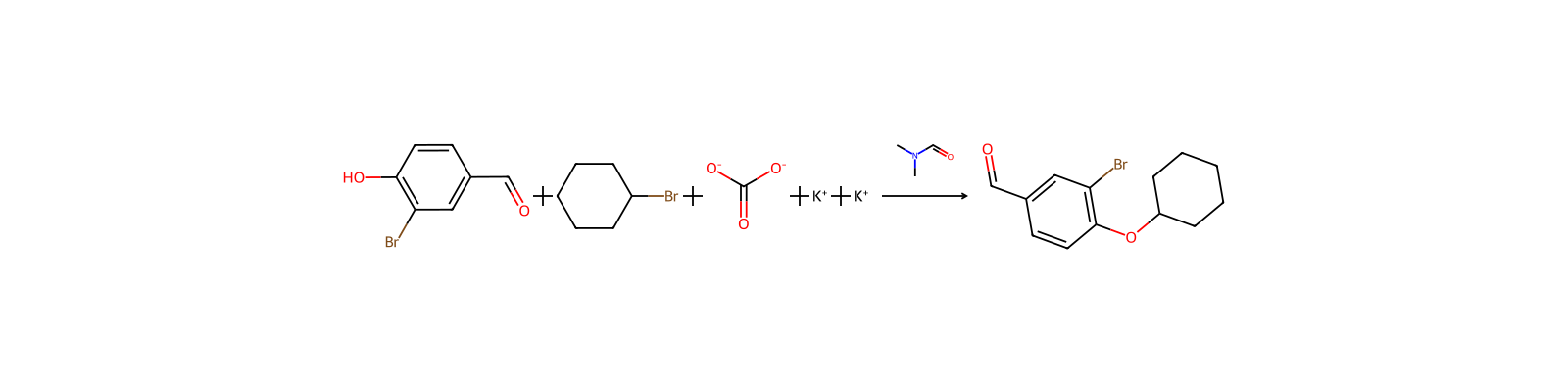
[Br:1][C:2]1[CH:3]=[C:4]([CH:7]=[CH:8][C:9]=1[OH:10])[CH:5]=[O:6].Br[CH:12]1[CH2:17][CH2:16][CH2:15][CH2:14][CH2:13]1.C([O-])([O-])=O.[K+].[K+]>CN(C=O)C>[Br:1][C:2]1[CH:3]=[C:4]([CH:7]=[CH:8][C:9]=1[O:10][CH:12]1[CH2:17][CH2:16][CH2:15][CH2:14][CH2:13]1)[CH:5]=[O:6]Participants
5
Reactant 3



Product 1

Reagents, catalysts & solvents 1

Conditions
- Temperature
- 90 °C
Procedure
3-Bromo-4-hydroxy-benzaldehyde (24.8 mmol, 5.0 g), bromo-cyclohexane (37.3 mmol, 6.08 g) and K2CO3 (37.3 mmol, 5.15 g) were suspended in DMF (15 mL) and stirred over night at 90° C. The mixture was cooled to room temperature, and bromo-cyclohexane (36.8 mmol, 6.0 g) and K2CO3 (36.2 mmol, 5.0 g) were added stirred at 90° C. for another 24 h. The mixture was cooled and filtered. The filtrate was extracted with ethyl acetate. The organic layer was washed with 1.0 N NaOH (200 mL), water, and brine, dried (Na2SO4), filtered, and concentrated under reduced pressure to provide 3-bromo-4-cyclohexyloxy-benzaldehyde (2.7 g).
Workup
- temperatureThe mixture was cooled to room temperature
- stirringstirred at 90° C. for another 24 h
- temperatureThe mixture was cooled
- filtrationfiltered
- extractionThe filtrate was extracted with ethyl acetate
- washThe organic layer was washed with 1.0 N NaOH (200 mL), water, and brine
- dry with materialdried (Na2SO4)
- filtrationfiltered
- concentrationconcentrated under reduced pressure
Sources & evidence
- ORD record
- ord-c693c0edef2840129bbc2139c0b0b34c
- Source dataset
- uspto-grants-2014_06
- Patent number
- US08741900B2
Reaction notes
Loading…