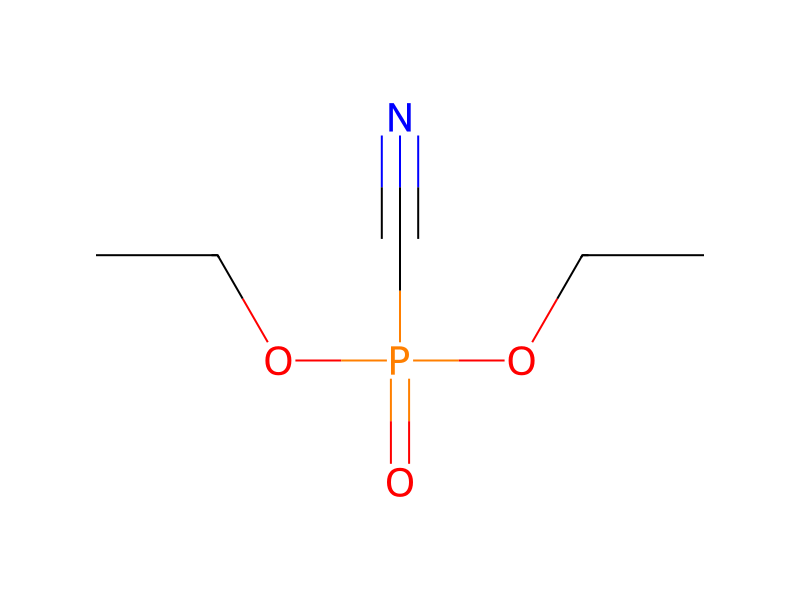
Diethyl cyanophosphonate → HCID 88118032, compound
Reaction equation

[C:1]([O:5][C:6](=[O:18])[N:7]([C:9]1[CH:14]=[C:13]([S:15][CH3:16])[CH:12]=[CH:11][C:10]=1[NH2:17])[CH3:8])([CH3:4])([CH3:3])[CH3:2].[O:19]=[C:20]1[NH:24][C:23](=[O:25])[CH:22]([CH2:26][C:27]2[CH:37]=[CH:36][C:30]([O:31][CH2:32][C:33](O)=[O:34])=[CH:29][CH:28]=2)[S:21]1.C(P(=O)(OCC)OCC)#N>C(N(CC)CC)C.O1CCCC1>[C:1]([O:5][C:6](=[O:18])[N:7]([C:9]1[CH:14]=[C:13]([S:15][CH3:16])[CH:12]=[CH:11][C:10]=1[NH:17][C:33](=[O:34])[CH2:32][O:31][C:30]1[CH:29]=[CH:28][C:27]([CH2:26][CH:22]2[S:21][C:20](=[O:19])[NH:24][C:23]2=[O:25])=[CH:37][CH:36]=1)[CH3:8])([CH3:4])([CH3:2])[CH3:3]Participants
Reactant 3


Product 1

Reagents, catalysts & solvents 2


Procedure
To a mixture of N-(2-amino-5-methylthiophenyl)-N-methylcarbamic acid t-butyl ester (2.0 g) (obtained in Reference Example 4), 4-(2,4-dioxothiazolidin-5-ylmethyl)phenoxyacetic acid (2.31 g) (obtained in Reference Example 6), triethylamine (1.14 ml) and anhydrous tetrahydrofuran (40 ml) was added diethyl cyanophosphonate (1.34 g) and the resulting mixture was stirred at room temperature for 4 hours and allowed to stand overnight. To the reaction mixture were further added 4-(2,4-dioxothiazolidin-5-ylmethyl)phenoxyacetic acid (0.84 g), triethylamine (0.3 g) and diethyl cyanophosphate (0.49 g) and the resulting solution was stirred at room temperature for 1.5 hours. At the end of this time the reaction mixture was concentrated and the residue was partitioned between ethyl acetate and water. The ethyl acetate layer was washed with saturated aqueous sodium chloride solution, dried over anhydrous sodium sulfate and evaporated in vacuo. The resulting residue was chromatographed on a silica gel column using n-hexane/ethyl acetate (2/1) as the eluant to give the desired product (3.54 g).
Workup
- waitto stand overnight
- stirringthe resulting solution was stirred at room temperature for 1.5 hours
- concentrationAt the end of this time the reaction mixture was concentrated
- customthe residue was partitioned between ethyl acetate and water
- washThe ethyl acetate layer was washed with saturated aqueous sodium chloride solution
- dry with materialdried over anhydrous sodium sulfate
- customevaporated in vacuo
- customThe resulting residue was chromatographed on a silica gel column
Sources & evidence
- ORD record
- ord-a27ec639854d49f7bf7dd32cd5640db5
- Source dataset
- uspto-grants-2003_05
- Patent number
- US06569877B2
Reaction notes
Loading…