Hydrochloric Acid → HCID 21430479, compound
Reaction equation
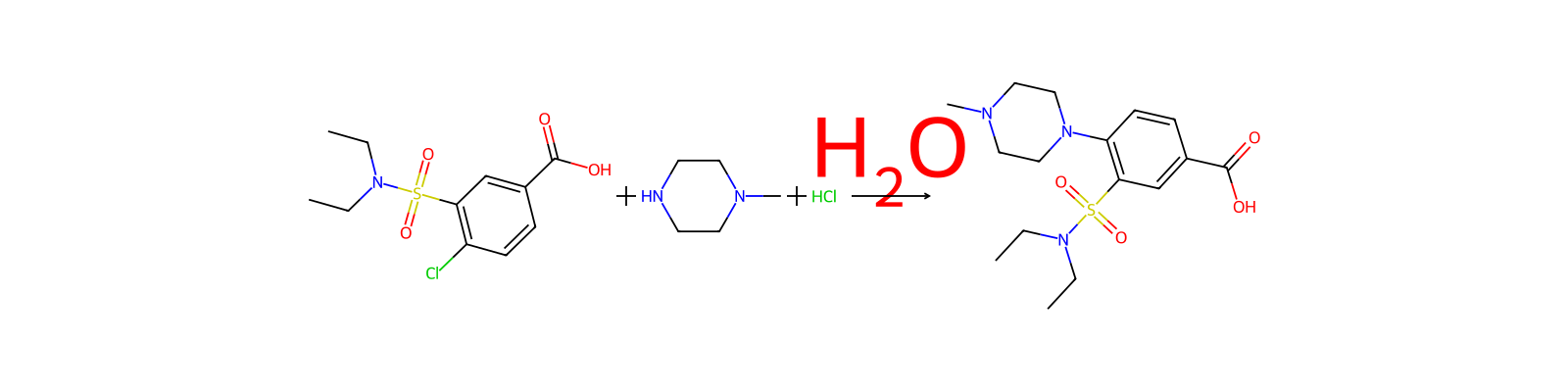
Cl[C:2]1[CH:10]=[CH:9][C:5]([C:6]([OH:8])=[O:7])=[CH:4][C:3]=1[S:11](=[O:18])(=[O:17])[N:12]([CH2:15][CH3:16])[CH2:13][CH3:14].[CH3:19][N:20]1[CH2:25][CH2:24][NH:23][CH2:22][CH2:21]1.Cl>O>[CH2:13]([N:12]([CH2:15][CH3:16])[S:11]([C:3]1[CH:4]=[C:5]([CH:9]=[CH:10][C:2]=1[N:23]1[CH2:24][CH2:25][N:20]([CH3:19])[CH2:21][CH2:22]1)[C:6]([OH:8])=[O:7])(=[O:18])=[O:17])[CH3:14]Participants
5
Reactant 3



Product 1

Reagents, catalysts & solvents 1

Conditions
- Temperature
- 80 °C
Procedure
29 Grams of 4-chloro-3-diethylsulfamoyl-benzoic acid were heated with 30 g of N-methylpiperazine for 4 hours at 140° C. Subsequently the reaction solution, which had cooled down to 80° C., was introduced into 0.4 l of water, and the solution was neutralized with 5N HCl. As soon as the precipitate, which was amorphous at first, became crystallized, it was suction-filtered and recrystallized from methanol.
Workup
- custombecame crystallized
- filtrationit was suction-filtered
- customrecrystallized from methanol
Sources & evidence
- ORD record
- ord-77603e5be4f74524bc48c3710eec6500
- Source dataset
- uspto-grants-1977_06
- Patent number
- US04029787
Reaction notes
Loading…