Phenylacetic Acid → 1,3-Dihydro-3-oxo-5-isobenzofurancarboxylic acid
Reaction equation
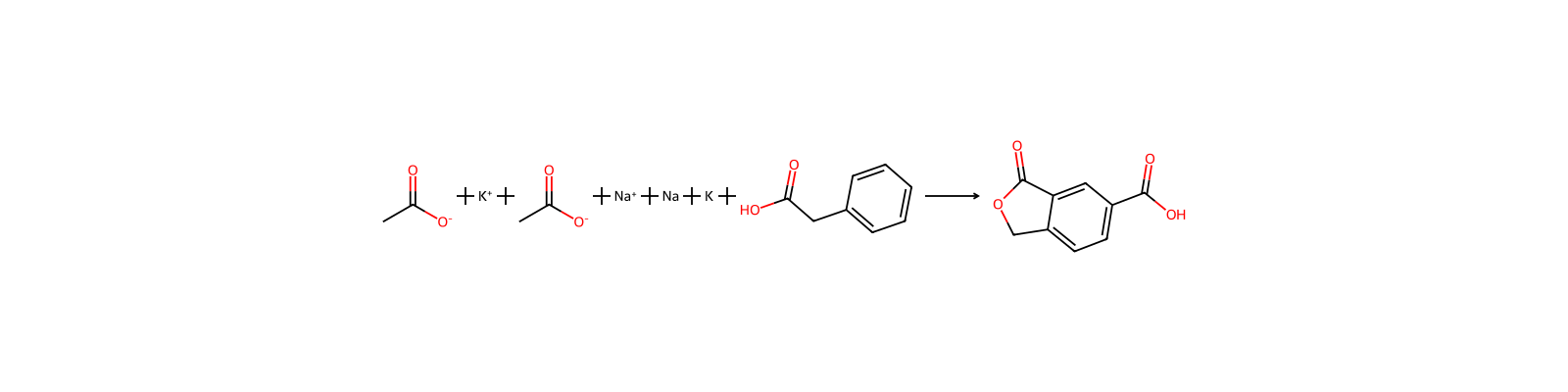
[C:1]([O-:4])(=[O:3])[CH3:2].[K+].[C:6]([O-])(=O)C.[Na+].[Na].[K].[C:13]1([CH2:19][C:20]([OH:22])=[O:21])[CH:18]=[CH:17][CH:16]=CC=1>>[C:1]1([C:2]2[C:17](=[CH:18][CH:13]=[C:19]([C:20]([OH:22])=[O:21])[CH:6]=2)[CH2:16][O:4]1)=[O:3]Participants
6






Procedure
By this method (schematically shown above) a 2-, 3- or 4- substituted phenylacetic acid (I) is reacted with benzene 1,2,4-tri-carboxylic anhydride (II) in about equimolar amounts at a temperature of about 200° to 280° C. in the presence of a suitable catalyst such as potassium acetate, sodium acetate or the sodium or potassium salt of the phenylacetic acid used. This results in a mixture of 3-(2-, 3- or 4-substituted benzylidene) phthalide-6-carboxylic acid (IIIa) and -5-carboxylic acid (IIIb).
Sources & evidence
- ORD record
- ord-aca919a76b374e13b78c8689801fc935
- Source dataset
- uspto-grants-1977_08
- Patent number
- US04041173
Reaction notes
Loading…