Triphenylphosphine → 2,6-Dichloro-9-cyclopropylpurine
Reaction equation

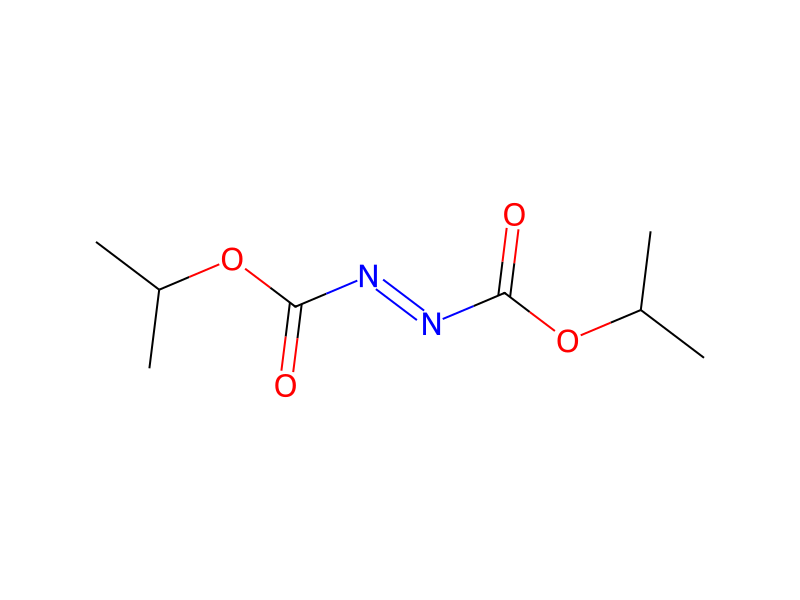
[Cl:1][C:2]1[N:10]=[C:9]2[C:5]([NH:6][CH:7]=[N:8]2)=[C:4]([Cl:11])[N:3]=1.C1(P([C:25]2[CH:30]=[CH:29]C=CC=2)C2C=CC=CC=2)C=CC=CC=1.C1(O)CC1.CC(OC(/N=N/C(OC(C)C)=O)=O)C>O1CCCC1>[Cl:1][C:2]1[N:10]=[C:9]2[C:5]([N:6]=[CH:7][N:8]2[CH:29]2[CH2:30][CH2:25]2)=[C:4]([Cl:11])[N:3]=1Participants
6





Conditions
- Temperature
- 0 °C
Procedure
2,6-Dichloropurine (1 mmol), triphenylphosphine (1.3 mmol), tetrahydrofurane (5 ml) and cyclopropanol (5 mmol) were stirred at rt under nitrogen to give clear yellowish solution, which was then cooled to 0° C. and diisopropyldiazadicarboxylate (DIAD; 1.3 mmol) was added via syringe. The reaction mixture was then stirred at rt for 12 h. After evaporation of the solvents the product was extracted with diethylether and purified by column chromatography (silicagel, 1% MeOH in CHCl3). Crystallization from methanol gave the product in yield 35%, mp 121-124° C.
Workup
- customto give clear yellowish solution, which
- customAfter evaporation of the solvents the product
- extractionwas extracted with diethylether
- custompurified by column chromatography (silicagel, 1% MeOH in CHCl3)
- customCrystallization from methanol
- customgave the product in yield 35%, mp 121-124° C.
Sources & evidence
- ORD record
- ord-1588bcbed76247d18f369896691036af
- Source dataset
- uspto-grants-2013_07
- Patent number
- US08492391B2
Reaction notes
Loading…