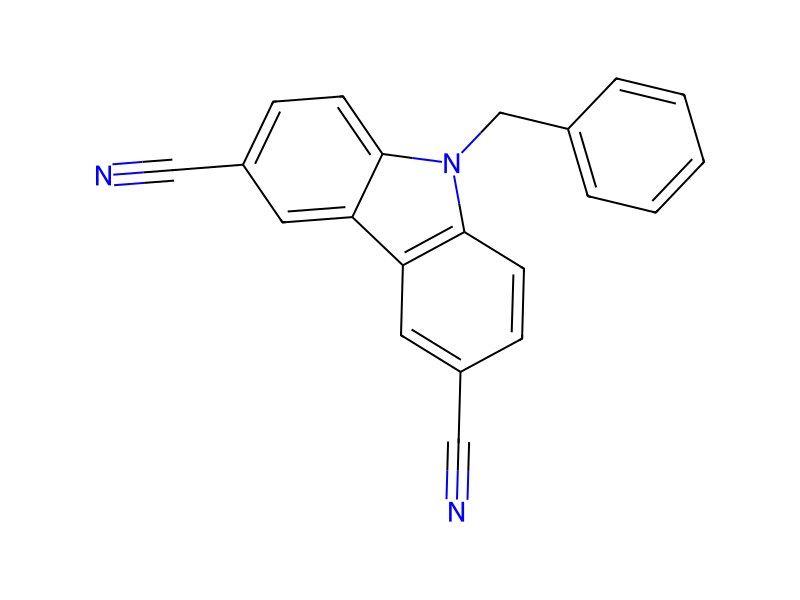
Water → 9-Benzyl-3,6-dicyanocarbazole
Reaction equation

[H-].[Na+].[C:3]([C:5]1[CH:6]=[CH:7][C:8]2[NH:9][C:10]3[C:15]([C:16]=2[CH:17]=1)=[CH:14][C:13]([C:18]#[N:19])=[CH:12][CH:11]=3)#[N:4].[CH2:20](Br)[C:21]1[CH:26]=[CH:25][CH:24]=[CH:23][CH:22]=1.O>CN(C)C=O>[CH2:20]([N:9]1[C:10]2[CH:11]=[CH:12][C:13]([C:18]#[N:19])=[CH:14][C:15]=2[C:16]2[C:8]1=[CH:7][CH:6]=[C:5]([C:3]#[N:4])[CH:17]=2)[C:21]1[CH:26]=[CH:25][CH:24]=[CH:23][CH:22]=1Participants
6
Reactant 4




Product 1
Reagents, catalysts & solvents 1

Conditions
- Temperature
- 110 °C
Procedure
A slurry of sodium hydride (50% in oil, 960 mg) in 100 ml of dimethylformamide is treated with 3,6-dicyanocarbazole (4.34 g, see Example 1) and heated at 110° C for two hours. The reaction mixture is then treated dropwise with benzylbromide (3.42 g) and heated at 110° C for an additional 18 hours. The reaction mixture is poured into water and extracted several times with dichloromethane. The combined dichloromethane extracts are dried over sodium sulfate and filtered through 200 ml of silica gel to yield 4.9 g of the title compound, melting point 265°-267° C.
Workup
- temperatureheated at 110° C for an additional 18 hours
- extractionextracted several times with dichloromethane
- dry with materialThe combined dichloromethane extracts are dried over sodium sulfate
- filtrationfiltered through 200 ml of silica gel
Sources & evidence
- ORD record
- ord-7cec077cb34c443e804fe683efd50ce5
- Source dataset
- uspto-grants-1977_12
- Patent number
- US04061655
Reaction notes
Loading…