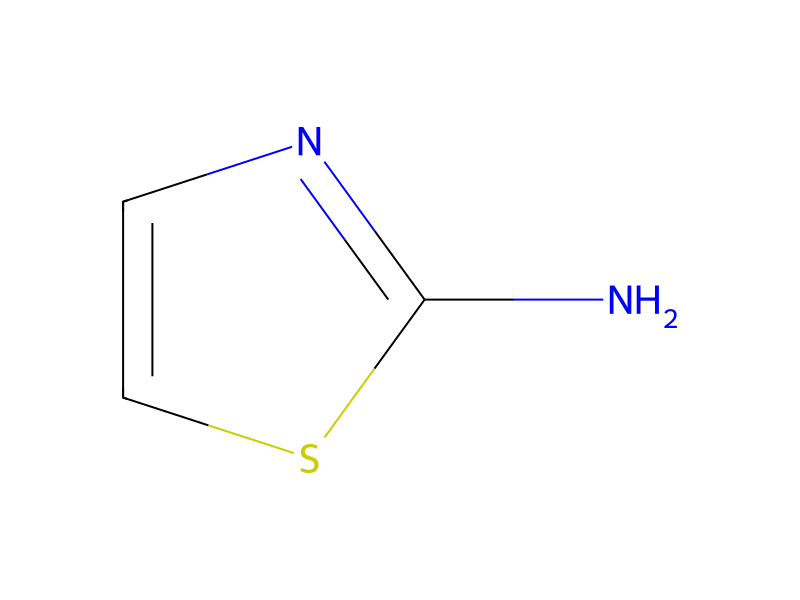
2-Aminothiazole → 4-formyl-N-(2-thiazolyl)benzamide
Reaction equation

[NH2:1][C:2]1[S:3][CH:4]=[CH:5][N:6]=1.C(N(CC)C(C)C)(C)C.[CH:16]([C:18]1[CH:26]=[CH:25][C:21]([C:22](Cl)=[O:23])=[CH:20][CH:19]=1)=[O:17]>CN(C)C1C=CN=CC=1>[CH:16]([C:18]1[CH:26]=[CH:25][C:21]([C:22]([NH:1][C:2]2[S:3][CH:4]=[CH:5][N:6]=2)=[O:23])=[CH:20][CH:19]=1)=[O:17]Participants
5
Reactant 3


Product 1

Reagents, catalysts & solvents 1

Procedure
In the same manner as that described in Example 2(1), a reaction was carried out using commercially available 2-aminothiazole (333 mg, 3.3 mmol), N,N-diisopropylethylamine (1.21 ml, 7.0 mmol), 4-formylbenzoyl chloride (468 mg, 2.8 mmol) and 4-(dimethylamino)pyridine (a catalytic amount) and the reaction mixture was treated according to a similar procedure to that described in Example 2(1) to afford 4-formyl-N-(2-thiazolyl)benzamide (355 mg, yield 55%) as a pale yellow solid which was recrystallized from ethyl acetate-hexane to give pale yellow powdery crystals.
Workup
- additionwas treated
Sources & evidence
- ORD record
- ord-4ac4cde1ba404d3aa976d37acdab19e0
- Source dataset
- uspto-grants-2003_11
- Patent number
- US06653330B2
Reaction notes
Loading…