Ethyl Acrylate → Ethyl 3-[2-(2,2-dimethylpropyl)benzoxazol-5-yl]propenoate
Reaction equation
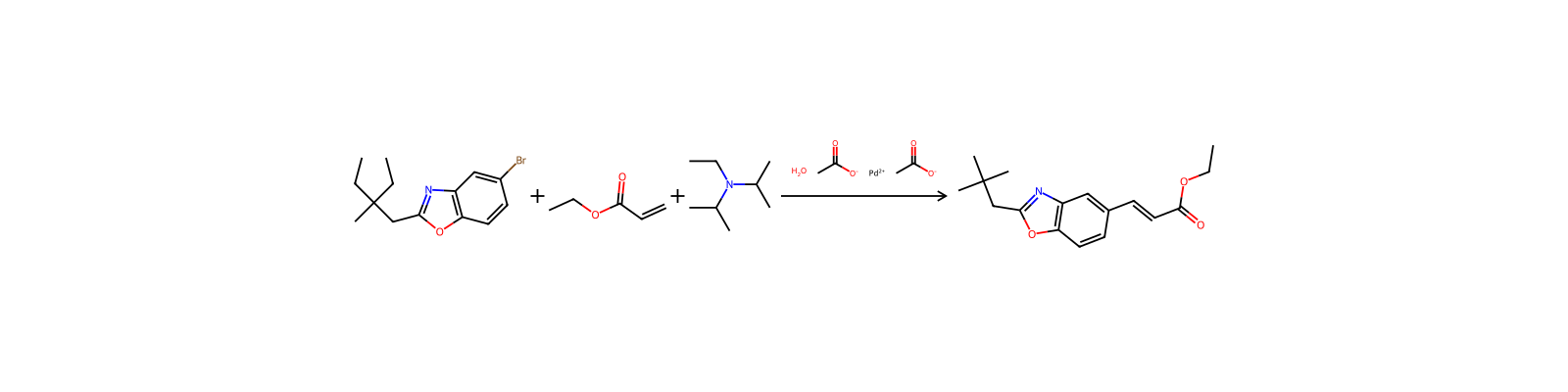
[CH2:1]([C:3]([CH2:16]C)([CH3:15])[CH2:4][C:5]1[O:6][C:7]2[CH:13]=[CH:12][C:11](Br)=[CH:10][C:8]=2[N:9]=1)C.[C:18]([O:22][CH2:23][CH3:24])(=[O:21])[CH:19]=[CH2:20].C(N(CC)C(C)C)(C)C>O.C([O-])(=O)C.[Pd+2].C([O-])(=O)C>[CH3:16][C:3]([CH3:1])([CH3:15])[CH2:4][C:5]1[O:6][C:7]2[CH:13]=[CH:12][C:11]([CH:20]=[CH:19][C:18]([O:22][CH2:23][CH3:24])=[O:21])=[CH:10][C:8]=2[N:9]=1Participants
6






Conditions
- Temperature
- 100 °C
Procedure
A mixture of 2-(2,2-diethylpropyl)-5-bromobenzoxazole (0.60 g, 0.00225 mol), ethyl acrylate (1.08 g, 0.0108 mol), palladium acetate (0.051 g, 0.00023 mol), trintolylphosphine (0.135 g,0.0045 mol) and N,N-diisopropylethylamine (0.585 g, 0.0045 mol) was heated at 100° C. for 6 hours. The mixture was cooled to room temperature, diluted with water and extracted with ethyl acetate. The organic extracts were dried over anhydrous magnesium sulfate, filtered and the filtrate was evaporated in vacuo. The residue was purified by flash column chromatography on silica gel, eluting with ethyl acetate:dichloromethane 3:97, to give ethyl 3-[2-(2,2-dimethylpropyl)benzoxazol-5-yl]propenoate (0.634 g).
Workup
- temperatureThe mixture was cooled to room temperature
- extractionextracted with ethyl acetate
- dry with materialThe organic extracts were dried over anhydrous magnesium sulfate
- filtrationfiltered
- customthe filtrate was evaporated in vacuo
- customThe residue was purified by flash column chromatography on silica gel
- washeluting with ethyl acetate:dichloromethane 3:97
Sources & evidence
- ORD record
- ord-a632a874053e4fed82007d7d2fc4ef80
- Source dataset
- uspto-grants-2004_03
- Patent number
- US06703347B2
Reaction notes
Loading…