Piperazine → 1-Tritylpiperazine
Reaction equation

[NH:1]1[CH2:6][CH2:5][NH:4][CH2:3][CH2:2]1.[C:7]1([C:13](Cl)([C:20]2[CH:25]=[CH:24][CH:23]=[CH:22][CH:21]=2)[C:14]2[CH:19]=[CH:18][CH:17]=[CH:16][CH:15]=2)[CH:12]=[CH:11][CH:10]=[CH:9][CH:8]=1>O1CCCC1>[C:13]([N:1]1[CH2:6][CH2:5][NH:4][CH2:3][CH2:2]1)([C:7]1[CH:12]=[CH:11][CH:10]=[CH:9][CH:8]=1)([C:20]1[CH:21]=[CH:22][CH:23]=[CH:24][CH:25]=1)[C:14]1[CH:15]=[CH:16][CH:17]=[CH:18][CH:19]=1Participants
4
Reactant 2

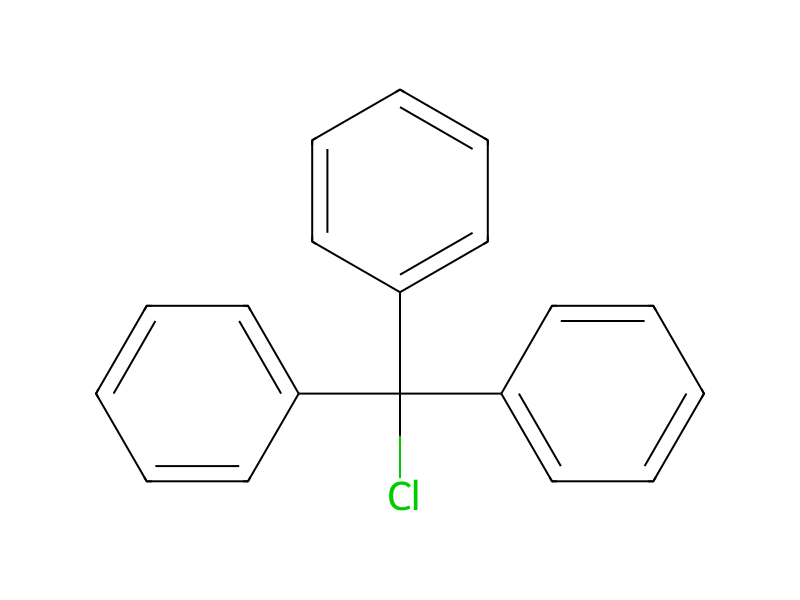
Product 1

Reagents, catalysts & solvents 1

Procedure
To a solution of piperazine (25.9 g, 0.30 mol) in tetrahydrofuran (300 ml) at 0° C. was added triphenylmethyl chloride (27.9 g, 0.10 mol). The reaction was stirred for 48 hours at room temperature. The product was extracted from aqueous sodium carbonate with three portions of ether. The combined organic layers were washed with three portions of water, dried with sodium sulfate, and the volatiles were then evaporated. The residue was subjected to chromatography on silica (LPS-1) (eluting with 90:10:4 ether/acetonitrile/triethylamine) to yield 7.62 g of N-tritylpiperazine.
Workup
- extractionThe product was extracted from aqueous sodium carbonate with three portions of ether
- washThe combined organic layers were washed with three portions of water
- dry with materialdried with sodium sulfate
- customthe volatiles were then evaporated
Sources & evidence
- ORD record
- ord-36d51ed950354c24a52cd00551ba5d02
- Source dataset
- uspto-grants-1986_03
- Patent number
- US04576749
Reaction notes
Loading…