Hydrochloric Acid → Pyrene
Reaction equation

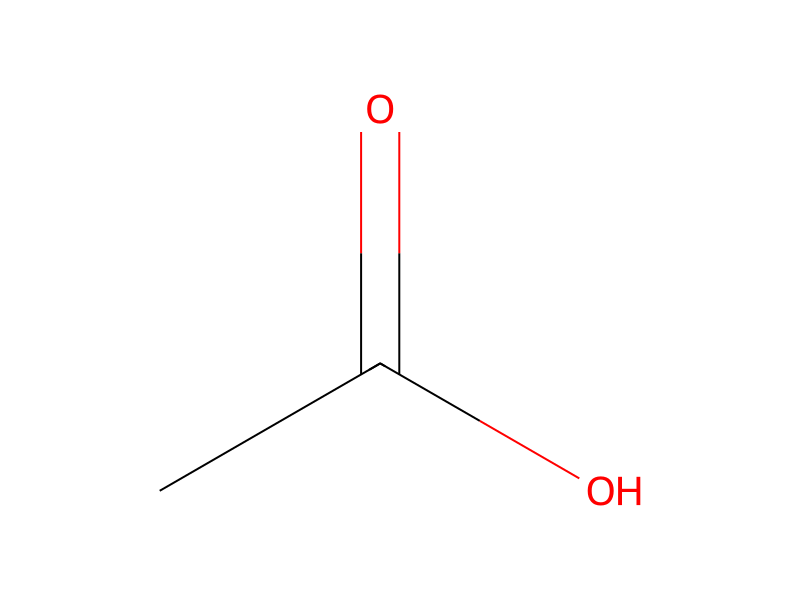
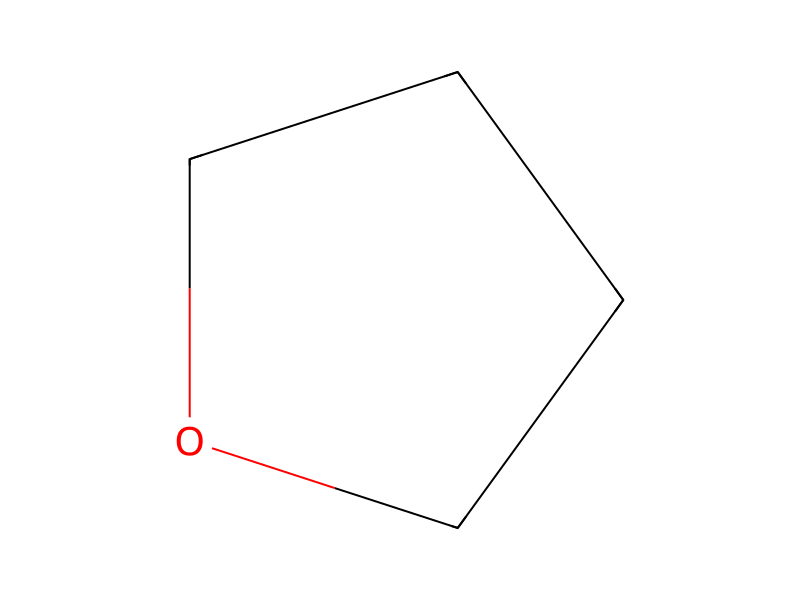
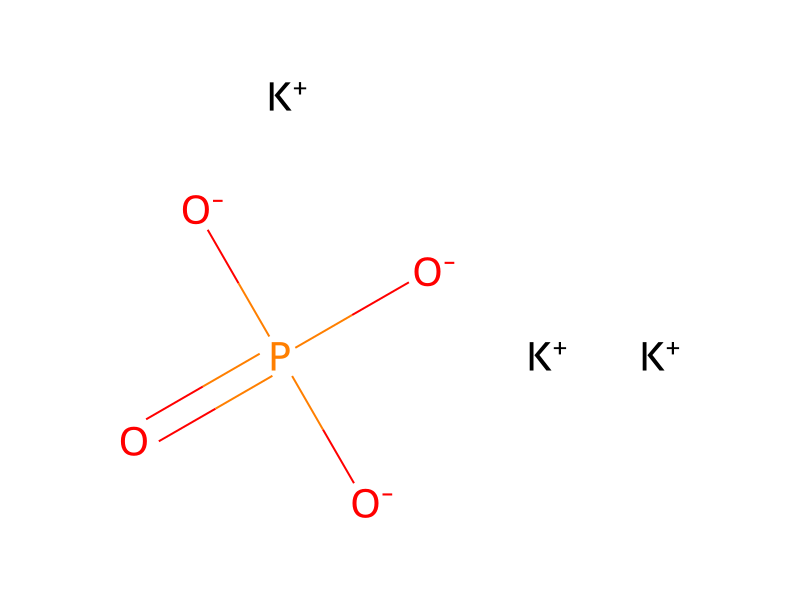
O=[CH:2][C@@H:3]([C@H:5]([C@H:7]([C@@H:9]([CH2:11]O)O)O)O)O.Cl.[OH-].[Na+].[BH4-].[Na+]>P([O-])([O-])([O-])=O.[K+].[K+].[K+].O.O1CCCC1.C(O)(=O)C>[CH:2]1[C:7]2[C:2]3=[C:3]4[C:2](=[CH:3][CH:5]=2)[CH:11]=[CH:9][CH:7]=[C:5]4[CH:11]=[CH:9][C:7]3=[CH:5][CH:3]=1Participants
Reactant 4
Product 1

Reagents, catalysts & solvents 4
Procedure
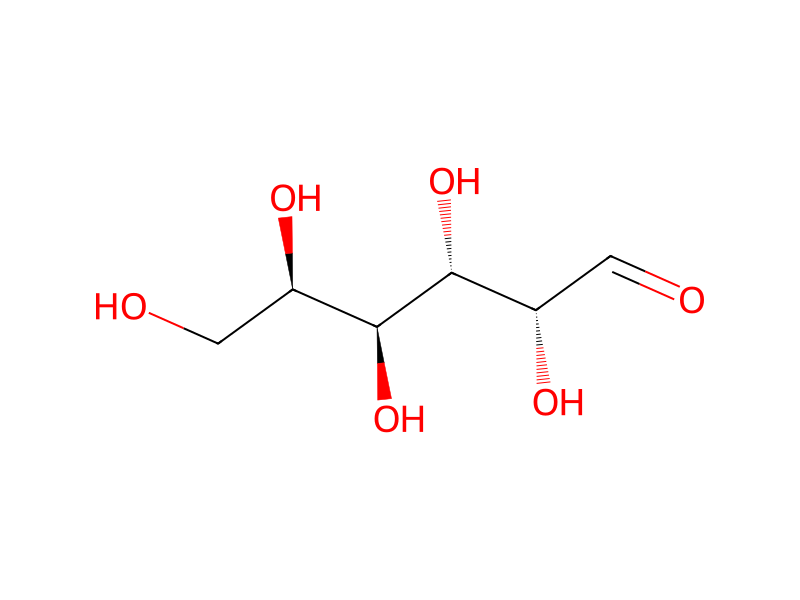
In a typical preparation, 49.5 μmol of the oligosaccharide was dissolved in 1.25 mL of 0.1 M potassium phosphate, pH 6.0. Approximately 10 units of Dactylium dendroides galactose oxidase (EC 1.1.3.9, Worthington Biochemical Corp.) dissolved in 1.25 mL of water and approximately 180 units of catatase (E.C. 1.11.1.6, Sigma Chem. Co., from bovine liver) were added, and the solution was stirred gently for 30 min at room temperature. The pH was then lowered to 5.6 with 0.1 N HCl and 16.5 μmol of 4-(1-pyrene)butyryl hydrazide (Molecular Probes, Inc., Plano, TX) dissolved in 2.5 mL of tetrahydrofuran added. The reaction mixture was stirred at 37° C. for 2 h and then overnight at room temperature. For reduction of the Schiff's base, the pH was raised to 8.3 with 1 N NaOH, 3.75 mg of NaBH4 dissolved in 0.1 mL of ice-cold H2O was added, and the mixture was stirred for 30 min at room temperature and then 4 hours at 4° C. The pH was lowered to 5 with glacial acetic acid and the material concentrated on a rotary evaporator (40°-45° C.) to 150-300 μL. The reaction yields were usually greater than 90%. The products were purified by thin-layer chromatography on 1-mm-thick silica gel plates (Brinkmann Instruments, Inc., SIL G-100 UV 254). Each plate was developed initially in CHCl3 /CH3OH solution (9/1 v/v) to remove unreacted PBH from the reaction product, which remained at the origin. After the plate dried, it was developed in the same direction in n-butyl alcohol/glacial acetic acid/water (4/1/2 v/v/v). In this solvent system, each of the pyrenebutyryl hydrazide derivatives of lactose (LPBH), raffinose (RPBH), and stachyose (SPBH) moved as a major fluorescent band with Rf values of 0.78, 0.35, and 0.20, respectively. Each fluorescent band was scraped and desorbed from the silica by three successive washes with 2 mL of ice-cold water. Nonfluorescent impurities extracted from the silica were removed by adsorbing the product on a small reverse-phase chromatography column (SEP-PAK C18, Waters Associates, Milford, MA) followed by elution with CH3OH/H2O (3/1 v/v). Most of the methanol was then evaporated under a N2 stream at room temperature, the final product was lyophilized and dissolved in an isotonic "wash" buffer (30 mM sodium phosphate, pH 7.4, 117 mM NaCl, and 2.8 mM KCl) to give a final concentration of 0.5-2.0 mM in terms of pyrene, and the stock solutions were stored frozen at -20° C. Assay of the products yielded pyrene/oligosaccharide molar ratios of 0.85-1.1 for various preparations of LPBH, RPBH, and SPBH. Preparations of SPBH were also purified by high-pressure liquid chromatograhy using a reverse-phase C18 column (Waters Associates) and a linear gradient of CH3OH in H2O (50-100%, v/v). The results were similar with SPBH purified by either thin-layer or high-pressure liquid chromatography.
Workup
- additionapproximately 180 units of catatase (E.C. 1.11.1.6, Sigma Chem. Co., from bovine liver) were added
- additionadded
- stirringThe reaction mixture was stirred at 37° C. for 2 h
- customovernight
- customat room temperature
- additionwas added
- stirringthe mixture was stirred for 30 min at room temperature
- custom4 hours
- customat 4° C
- concentrationthe material concentrated on a rotary evaporator (40°-45° C.) to 150-300 μL
- customThe reaction yields
- customThe products were purified by thin-layer chromatography on 1-mm-thick silica gel plates (Brinkmann Instruments, Inc., SIL G-100 UV 254)
- customto remove unreacted PBH from the reaction product, which
- customAfter the plate dried
- extractionNonfluorescent impurities extracted from the silica
- customwere removed
- washfollowed by elution with CH3OH/H2O (3/1 v/v)
- customMost of the methanol was then evaporated under a N2 stream at room temperature
- dissolutiondissolved in an isotonic "
- washwash" buffer (30 mM sodium phosphate, pH 7.4, 117 mM NaCl, and 2.8 mM KCl)
Sources & evidence
- ORD record
- ord-c59b55a48bad4385b191bd743b9bfc9c
- Source dataset
- uspto-grants-1985_08
- Patent number
- US04537718
Reaction notes
Loading…