Hydrochloric Acid → Triphenylphosphine Oxide
Reaction equation

[C:1]1([P:7]([C:14]2[CH:19]=[CH:18][CH:17]=[CH:16][CH:15]=2)[C:8]2[CH:13]=[CH:12][CH:11]=[CH:10][CH:9]=2)[CH:6]=[CH:5][CH:4]=[CH:3][CH:2]=1.Cl.[O:21]1CCOCC1>>[C:14]1([P:7](=[O:21])([C:1]2[CH:2]=[CH:3][CH:4]=[CH:5][CH:6]=2)[C:8]2[CH:13]=[CH:12][CH:11]=[CH:10][CH:9]=2)[CH:15]=[CH:16][CH:17]=[CH:18][CH:19]=1Participants
4



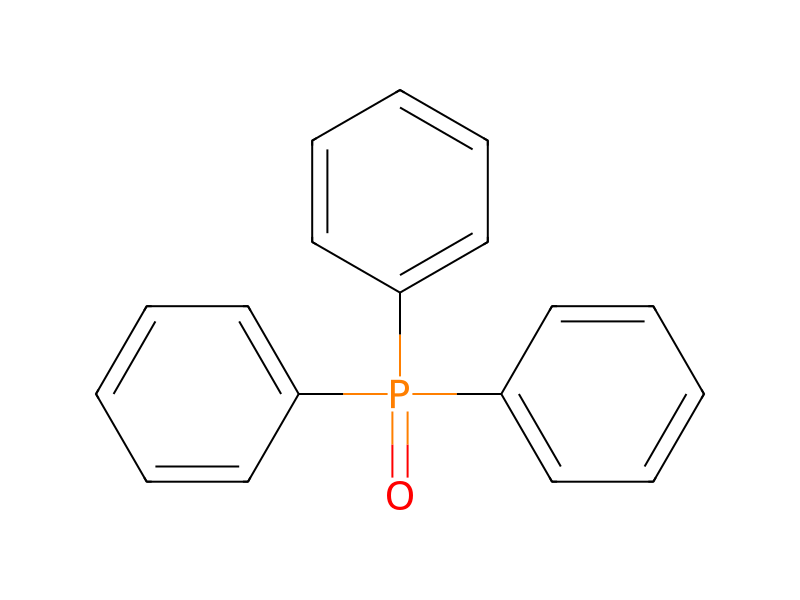
Procedure
Intermediate 2 (25.72 g, 40 mmol) was suspended in a solution of triphenylphosphine (10.94 g, 41.7 mmol) and 5% aqueous hydrochloric acid (2 mL) in 1,4-dioxane (200 mL). Stirring at room temperature in a stoppered flask for 2 h produced a solution of the product 3 and triphenylphosphine oxide. The reaction was worked up with ether and brine giving a solid from which 3 was extracted with hexanes at room temperature. The yield of 3 was 26.58 g (82.4 mmol, 103%).
Sources & evidence
- ORD record
- ord-e53240fc3a5047ec8bd583702abcb161
- Source dataset
- uspto-grants-2005_12
- Patent number
- US06974662B2
Reaction notes
Loading…