Dimethylformamide dimethyl acetal → 3-Amino-4-(2,2-dimethoxyethyl)benzamide
Reaction equation

[N+:1]([C:4]1[CH:5]=[C:6]([CH:10]=[CH:11][C:12]=1[CH3:13])[C:7]([NH2:9])=[O:8])([O-])=O.[CH3:14][O:15][CH:16]([O:20][CH3:21])N(C)C.[H][H]>CN(C)C=O>[NH2:1][C:4]1[CH:5]=[C:6]([CH:10]=[CH:11][C:12]=1[CH2:13][CH:16]([O:20][CH3:21])[O:15][CH3:14])[C:7]([NH2:9])=[O:8]Participants
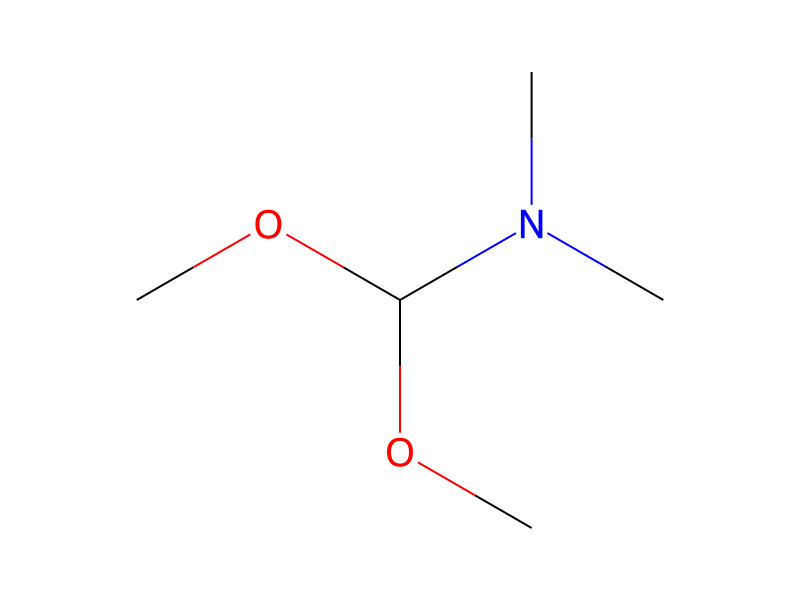




Conditions
- Temperature
- 140 °C
Procedure
19.5 g of 3-nitro-4-methylbenzamide and 30 g of dimethylformamide dimethyl acetal were dissolved in 200 ml of dimethylformamide. The obtained mixture was stirred at 140° C. for 20 hours. The mixture was then concentrated under a reduced pressure. Thereafter, 360 ml of methanol and 25 g of chlorotrimethylsilane were added to the residue. The obtained solution was heated to reflux for 16 hours. The reaction solution was cooled and then concentrated under a reduced pressure. Water and ethyl acetate were added thereto, so as to divide an organic layer. The organic layer was separated, and then washed with a saturated sodium bicarbonate aqueous solution and a saturated sodium chloride solution. It was then dried over anhydrous magnesium sulfate. The mixture was filtered through 100 g of a silica gel layer, and then washed with ethyl acetate. Thereafter, the filtrate was concentrated under a reduced pressure. 0.9 g of 10% palladium carbon was added to 150 ml of a methanol solution containing the obtained crude product, and the mixture was intensively stirred in a hydrogen atmosphere. After completion of the reaction, the catalyst was removed by filtration, and the filtrate was concentrated under a reduced pressure. The obtained residue was purified by NH silica gel column chromatography (hexane/ethyl acetate), so as to obtain 11.5 g of the subject compound.
Workup
- concentrationThe mixture was then concentrated under a reduced pressure
- additionThereafter, 360 ml of methanol and 25 g of chlorotrimethylsilane were added to the residue
- temperatureThe obtained solution was heated
- temperatureto reflux for 16 hours
- temperatureThe reaction solution was cooled
- concentrationconcentrated under a reduced pressure
- additionWater and ethyl acetate were added
- customThe organic layer was separated
- washwashed with a saturated sodium bicarbonate aqueous solution
- dry with materialIt was then dried over anhydrous magnesium sulfate
- filtrationThe mixture was filtered through 100 g of a silica gel layer
- washwashed with ethyl acetate
- concentrationThereafter, the filtrate was concentrated under a reduced pressure
- addition0.9 g of 10% palladium carbon was added to 150 ml of a methanol solution
- additioncontaining the
- customobtained crude product
- customAfter completion of the reaction
- customthe catalyst was removed by filtration
- concentrationthe filtrate was concentrated under a reduced pressure
- customThe obtained residue was purified by NH silica gel column chromatography (hexane/ethyl acetate)
Sources & evidence
- ORD record
- ord-6de73e576d034d3393745071b94d85e4
- Source dataset
- uspto-grants-2009_05
- Patent number
- US07538123B2
Reaction notes
Loading…