Sodium Iodide → Di-n-decyl ether
Reaction equation

[CH2:1]([O:11][CH2:12][CH2:13][CH2:14][OH:15])[CH2:2][CH2:3][CH2:4][CH2:5][CH2:6][CH2:7][CH2:8][CH2:9][CH3:10].[H-].[Na+].[Na+].[I-].C(O)CCO.[H][H].[CH2:27](Cl)[CH2:28][CH2:29][CH2:30][CH2:31][CH2:32][CH2:33]CCC>CN(C=O)C.O>[CH2:1]([O:11][CH2:12][CH2:13][CH2:14][CH2:27][CH2:28][CH2:29][CH2:30][CH2:31][CH2:32][CH3:33])[CH2:2][CH2:3][CH2:4][CH2:5][CH2:6][CH2:7][CH2:8][CH2:9][CH3:10].[CH2:1]([O:11][CH2:12][CH2:13][CH2:14][OH:15])[CH2:2][CH2:3][CH2:4][CH2:5][CH2:6][CH2:7][CH2:8][CH2:9][CH3:10]Participants
Reactant 6

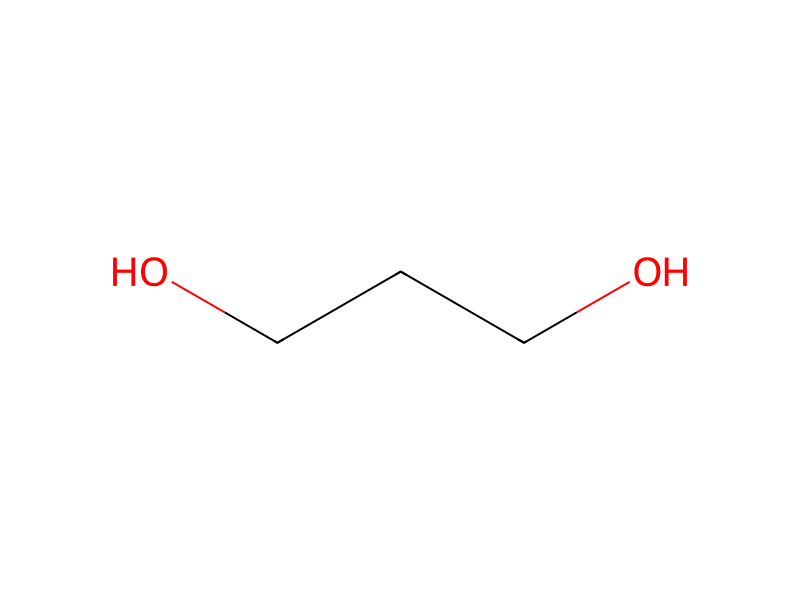




Product 2

Reagents, catalysts & solvents 2


Procedure
3-Hydroxypropyl decyl ether (Compound 17) To a mixture of NaH (2.6 g, 70 mmol) and anhydrous NaI (9.9 g, 70 mmol) in dry DMF (80 mL) under N2 was added dropwise a solution of 1,3-propanediol (4.75 mL, 70 mmol) in DMF (20 mL). The mixture was stirred until hydrogen evolution had ceased, decyl chloride (1.34 g, 7.6 mmol) was added and stirring was continued at 50° C. for 18 hours. Then, the reaction mixture was poured into H2O (300 mL) and extracted with diethyl ether (3×250 mL). The organic extracts were combined, washed with sat. NaCl (100 mL), dried (MgSO4) and evaporated to dryness. The residue was subjected to silica-gel column chromatography [eluent: ethyl acetate/hexane, 30/70, v/v] to furnish decyl ether Compound 17 as a colourless oil. 1H NMR (360 MHz; CDCl3): (0.87 (3 H, t, J 7 Hz, Me), 1.25 (14 H, br s, 7×CH2), 1.55 (2 H, quintet, J 7 Hz, (—H2), 1.82 (2 H, quintet, J 5.5 Hz, 2-H2), 2.62 (1 H, br s, OH), 3.41 (2 H, t, J 7.5 Hz, (—H2), 3.60 (2 H, t, J 5.5 Hz, 1-H2), and 3.77 (2 H, t, J 5.5 Hz, 3-H2); ESI-MS (m/z, +ve): 217 (MH+, 100%).
Workup
- extractionextracted with diethyl ether (3×250 mL)
- washwashed with sat. NaCl (100 mL)
- dry with materialdried (MgSO4)
- customevaporated to dryness
Sources & evidence
- ORD record
- ord-6e5657c7d7e241faa7c999ef85e28a71
- Source dataset
- uspto-grants-2005_09
- Patent number
- US06949528B1
Reaction notes
Loading…