Trityl chloride → 3-(Tritylamino)propan-1-ol
Reaction equation

[NH2:1][CH2:2][CH2:3][CH2:4][OH:5].Cl[C:7]([C:20]1[CH:25]=[CH:24][CH:23]=[CH:22][CH:21]=1)([C:14]1[CH:19]=[CH:18][CH:17]=[CH:16][CH:15]=1)[C:8]1[CH:13]=[CH:12][CH:11]=[CH:10][CH:9]=1.C(N(CC)CC)C>ClCCl.O>[OH:5][CH2:4][CH2:3][CH2:2][NH:1][C:7]([C:8]1[CH:13]=[CH:12][CH:11]=[CH:10][CH:9]=1)([C:20]1[CH:21]=[CH:22][CH:23]=[CH:24][CH:25]=1)[C:14]1[CH:15]=[CH:16][CH:17]=[CH:18][CH:19]=1Participants
6
Reactant 3
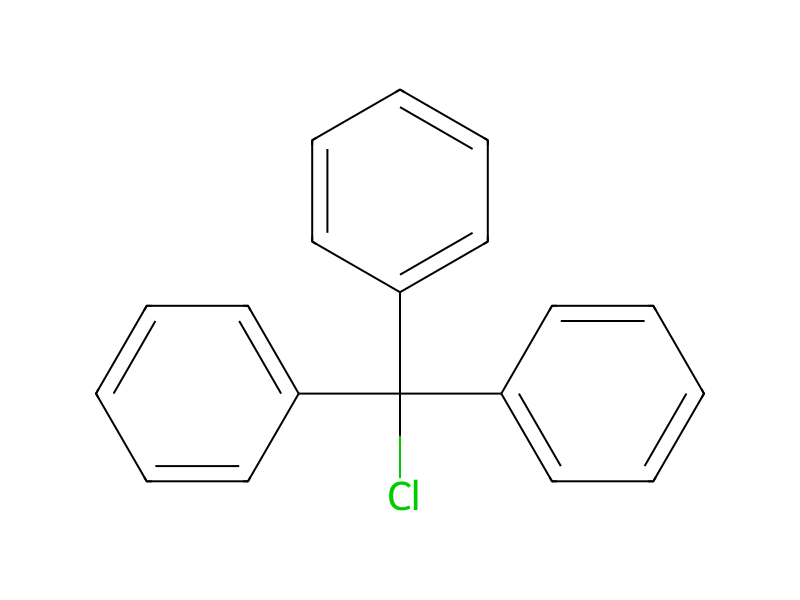


Product 1

Reagents, catalysts & solvents 2


Procedure
A mixture of 3-amino-1-propanol (51 ml, 0.66 mol), chlorotriphenylmethane (184 g, 0.66 mol) and triethylamine (92 ml, 0.66 mol) in dichloromethane (1000 ml) was stirred at room temperature for 18 hours. The reaction mixture was diluted with water and the layers separated. The aqueous phase was extracted with further dichloromethane (2×) and the combined organic extracts were dried (Na2SO4), filtered, and concentrated under reduced pressure. The residue was triturated well with diisopropyl ether, and the resulting solid was filtered and dried. This solid was then triturated with methanol, the suspension filtered, and the filtrate concentrated under reduced pressure, to give the title compound as a white solid, 139.1 g, 66% yield.
Workup
- customthe layers separated
- extractionThe aqueous phase was extracted with further dichloromethane (2×)
- dry with materialthe combined organic extracts were dried (Na2SO4)
- filtrationfiltered
- concentrationconcentrated under reduced pressure
- customThe residue was triturated well with diisopropyl ether
- filtrationthe resulting solid was filtered
- customdried
- customThis solid was then triturated with methanol
- filtrationthe suspension filtered
- concentrationthe filtrate concentrated under reduced pressure
Sources & evidence
- ORD record
- ord-8e61725cb96947129c14bb6d737a2cd6
- Source dataset
- uspto-grants-2005_09
- Patent number
- US06949577B2
Reaction notes
Loading…