Potassium Carbonate → 2-Chloro-3-cyclopropylpyridine
Reaction equation

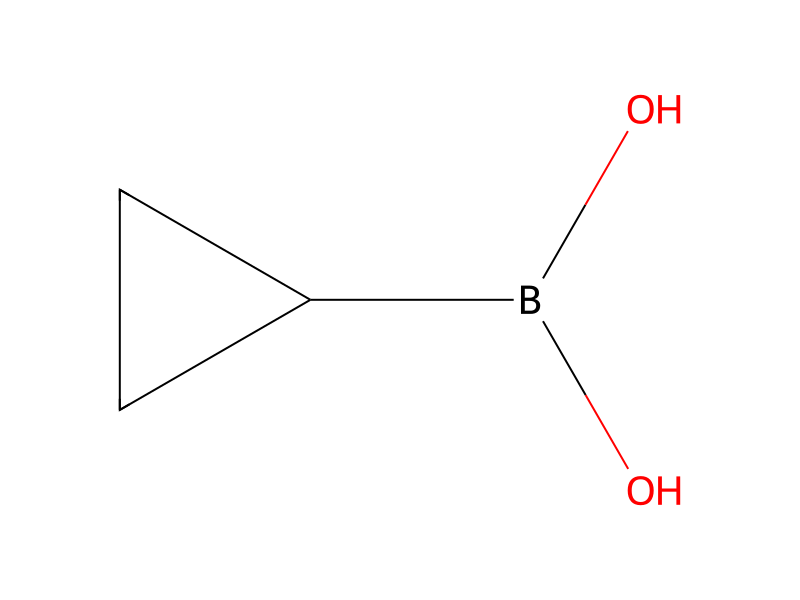
[Cl:1][C:2]1[C:7](I)=[CH:6][CH:5]=[CH:4][N:3]=1.[CH:9]1(B(O)O)[CH2:11][CH2:10]1.C(=O)([O-])[O-].[K+].[K+]>O1CCOCC1.C(OCC)(=O)C.C1C=CC([P]([Pd]([P](C2C=CC=CC=2)(C2C=CC=CC=2)C2C=CC=CC=2)([P](C2C=CC=CC=2)(C2C=CC=CC=2)C2C=CC=CC=2)[P](C2C=CC=CC=2)(C2C=CC=CC=2)C2C=CC=CC=2)(C2C=CC=CC=2)C2C=CC=CC=2)=CC=1>[Cl:1][C:2]1[C:7]([CH:9]2[CH2:11][CH2:10]2)=[CH:6][CH:5]=[CH:4][N:3]=1Participants
7






Conditions
- Temperature
- 120 °C
Procedure
To a mixture of 2-chloro-3-iodopyridine (2.39 g, 9.98 mmol), cyclopropylboronic acid (860 mg, 10 mmol) and potassium carbonate (4.14 g, 30.0 mmol) in 1,4-dioxane (50 mL) was added tetrakis(triphenylphosphine)palladium(0) (1.16 g, 1.00 mmol). The reaction mixture was stirred at 120° C. for 4 hours, then diluted with ethyl acetate (50 mL) and filtered. The filtrate was concentrated and the residue was purified by silica gel chromatography (Gradient: 10% to 30% ethyl acetate in petroleum ether) to afford the product as a colorless oil. Yield: 1 g, 6 mmol, 60%. 1H NMR (400 MHz, CDCl3) δ 8.20 (dd, J=4.7, 1.8 Hz, 1H), 7.24-7.28 (m, 1H), 7.14 (br dd, J=7.6, 4.8 Hz, 1H), 2.12-2.21 (m, 1H), 1.04-1.11 (m, 2H), 0.67-0.72 (m, 2H).
Workup
- filtrationfiltered
- concentrationThe filtrate was concentrated
- customthe residue was purified by silica gel chromatography (Gradient: 10% to 30% ethyl acetate in petroleum ether)
Sources & evidence
- ORD record
- ord-689aec9b2a224a34baaa0c37d82b226e
- Source dataset
- uspto-grants-2015_08
- Patent number
- US09107923B2
Reaction notes
Loading…