Benzyl Alcohol → HCID 2145438, compound
Reaction equation

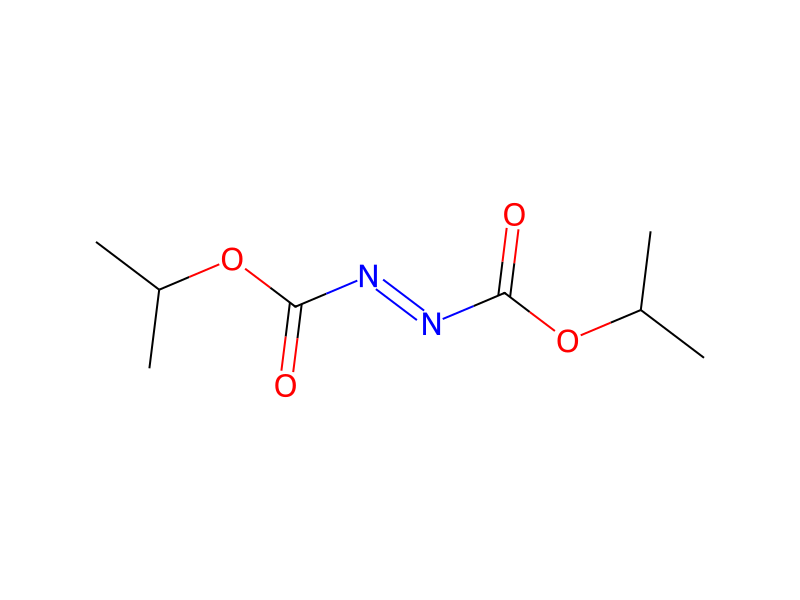
C1C=CC(P(C2C=CC=CC=2)C2C=CC=CC=2)=CC=1.CC(OC(/N=N/C(OC(C)C)=O)=O)C.[CH2:34]([OH:41])[C:35]1[CH:40]=[CH:39][CH:38]=[CH:37][CH:36]=1.[Br:42][C:43]1[C:44](=[O:54])[NH:45][C:46]2[C:51]([C:52]=1O)=[CH:50][CH:49]=[CH:48][CH:47]=2>C1COCC1>[CH2:34]([O:41][C:52]1[C:51]2[C:46](=[CH:47][CH:48]=[CH:49][CH:50]=2)[NH:45][C:44](=[O:54])[C:43]=1[Br:42])[C:35]1[CH:40]=[CH:39][CH:38]=[CH:37][CH:36]=1Participants
6
Reactant 4



Product 1

Reagents, catalysts & solvents 1

Conditions
- Temperature
- 0 °C
Procedure
To a 0° C. solution of PPh3 (1.64 g) in THF (42 mL) was added diisopropylazodicarboxylate (1.21 mL) dropwise. The mixture was stirred at 0° C. for 15 minutes before the addition of benzyl alcohol (0.52 mL) followed by quinoline alcohol from Step 1 (1.0 g). The mixture was stirred 15 minutes at 0° C. then 5 hours at room temperature. A suspension had formed at that point. The solid was filtered and washed with cold isopropanol to afford the desired product (0.78 g). LRMS (ES+) m/z 352.1 (M+Na)+.
Workup
- custom5 hours
- customat room temperature
- customA suspension had formed at that point
- filtrationThe solid was filtered
- washwashed with cold isopropanol
Sources & evidence
- ORD record
- ord-166622138bc84f3b9f4f3daa6cecfe38
- Source dataset
- uspto-grants-2016_05
- Patent number
- US09328138B2
Reaction notes
Loading…