Azidotrimethylsilane → 3-Chloro-6-(2H-1,2,3-triazol-4-yl)isoquinoline
Reaction equation

[Cl:1][C:2]1[N:3]=[CH:4][C:5]2[C:10]([CH:11]=1)=[CH:9][C:8]([C:12]#[CH:13])=[CH:7][CH:6]=2.[N:14]([Si](C)(C)C)=[N+:15]=[N-:16]>CN(C=O)C.C(OCC)(=O)C>[Cl:1][C:2]1[N:3]=[CH:4][C:5]2[C:10]([CH:11]=1)=[CH:9][C:8]([C:12]1[CH:13]=[N:16][NH:15][N:14]=1)=[CH:7][CH:6]=2Participants
5
Reactant 2
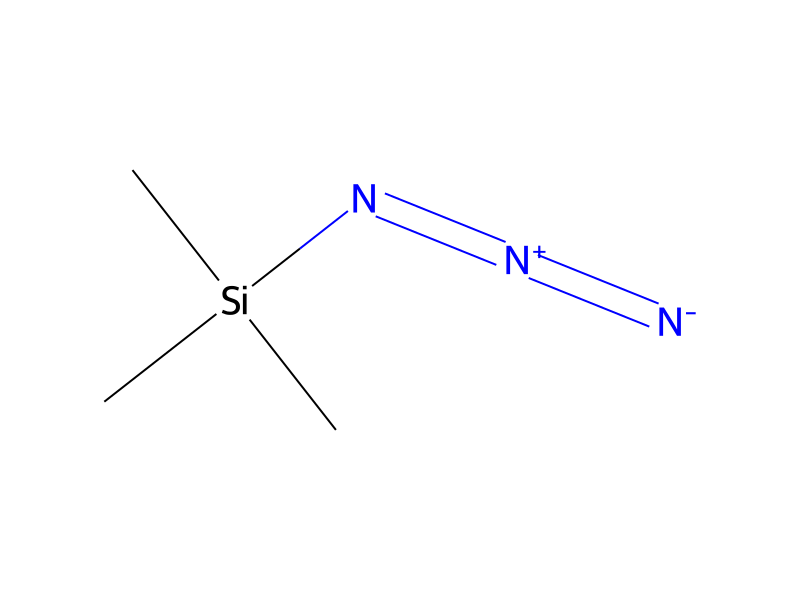

Product 1

Reagents, catalysts & solvents 2


Conditions
- Temperature
- 120 °C
Procedure
3-chloro-6-ethynylisoquinoline (Preparation 50, 120 mg, 0.64 mmol) was dissolved in dry DMF (1 mL). Azidotrimethylsilane (1 mL, 7.5 mmol) was added and the reaction stirred at 120° C. for 2 hours. The reaction was cooled to room temperature and diluted with ethyl acetate (20 mL). The organic solution was washed with water (20 mL), brine (20 mL), dried over sodium sulphate and concentrated in vacuo. The residue was purified using silica gel column chromatography eluting with 2% 7N NH3 in methanol in DCM followed by elution through an SCX-2 column using 50% methanol in chloroform followed by 50% 7N NH3 in methanol in chloroform to afford the title compound as a pale brown powder (90 mg, 61%).
Workup
- temperatureThe reaction was cooled to room temperature
- washThe organic solution was washed with water (20 mL), brine (20 mL)
- dry with materialdried over sodium sulphate
- concentrationconcentrated in vacuo
- customThe residue was purified
- washeluting with 2% 7N NH3 in methanol in DCM
- washfollowed by elution through an SCX-2 column
Sources & evidence
- ORD record
- ord-c19af088cac24e75b2d62f82f2dc7351
- Source dataset
- uspto-grants-2016_05
- Patent number
- US09334286B2
Reaction notes
Loading…