Hydrochloric Acid → 8-Bromo-5-benzylcarbamoyl-5,6-dihydro-1H-pyrrolo[1,2,3-de]quinoxaline-2,3-dione
Reaction equation

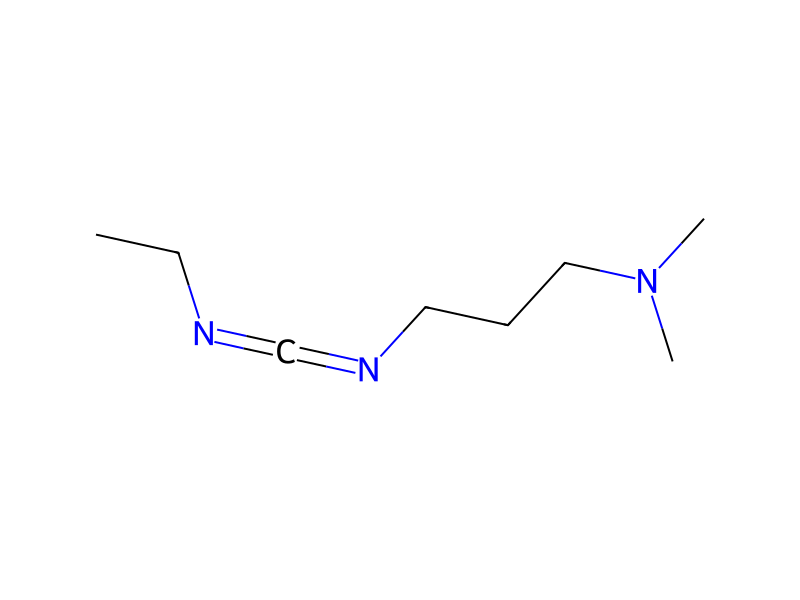
[Br:1][C:2]1[CH:3]=[C:4]2[CH2:15][CH:14]([C:16]([OH:18])=O)[N:6]3[C:7](=[O:13])[C:8](=[O:12])[NH:9][C:10]([CH:11]=1)=[C:5]23.[CH2:19]([NH2:26])[C:20]1[CH:25]=[CH:24][CH:23]=[CH:22][CH:21]=1.C(N=C=NCCCN(C)C)C.ON1C2C=CC=CC=2N=N1.Cl>CN(C=O)C>[Br:1][C:2]1[CH:3]=[C:4]2[CH2:15][CH:14]([C:16](=[O:18])[NH:26][CH2:19][C:20]3[CH:25]=[CH:24][CH:23]=[CH:22][CH:21]=3)[N:6]3[C:7](=[O:13])[C:8](=[O:12])[NH:9][C:10]([CH:11]=1)=[C:5]23Participants
Reactant 5




Product 1

Reagents, catalysts & solvents 1

Procedure
To a solution of 8-bromo-5-carboxy-5,6-dihydro-1H-pyrrolo[1,2,3-de]quinoxaline-2,3-dione (300 mg, 0.96 mmol) and benzylamine (114 mg, 1.06 mmol) in DMF (3 mL) was added 1-ethyl-3-(3'-dimethylaminopropyl)carbodiimide (164 mg, 1.06 mmol) and N-hydroxybenztriazole (162 mg, 1.06 mmol) at 0° C. The mixture was stirred at room temperature overnight and aqueous 0.1N HCl was added. The precipitates formed were collected by filtration, washed with distilled water, and dried in vacuo to give 384 mg of the title compound (99%): mp 152.5°~153° C.; 1H NMR (270 MHz, DMSO-d6) δ12.01 (s, 1 H), 11.52 (t, 1H, J=5.6 Hz), 7.34 (m, 5H), 7.21 (d, 1H, J=1 Hz), 7.07 (d, 1H, J=1 Hz), 5.17 (dd, 1H, J=17, 10 Hz), 4.32 (d, 2H, J=5.6 Hz), 3.74 (dd, 1H, J=17, 10 Hz), 3.20 (dd, 1H, J=17, 5 Hz).
Workup
- customThe precipitates formed
- filtrationwere collected by filtration
- washwashed with distilled water
- customdried in vacuo
Sources & evidence
- ORD record
- ord-2801dba1468b4e529c4a6955896b1b20
- Source dataset
- uspto-grants-1997_04
- Patent number
- US05616586
Reaction notes
Loading…