2,3-Dihydroxybutanedioic Acid → Nitric Acid
Reaction equation

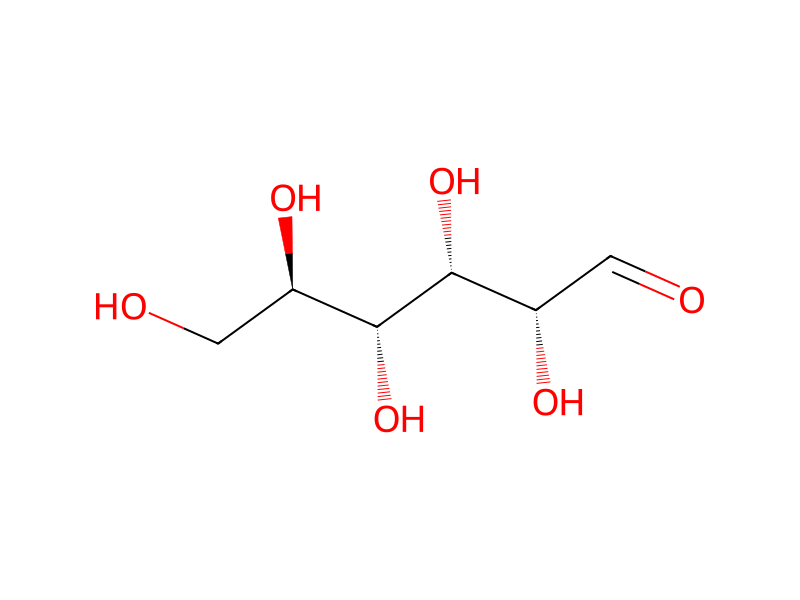
[N+:1]([O-:4])([OH:3])=[O:2].[C:5]([OH:14])(=O)[CH:6]([CH:8]([C:10]([OH:12])=O)[OH:9])[OH:7]>[V].[Mn].[Fe].[Mo]>[N+:1]([O-:4])([OH:3])=[O:2].[O:7]=[CH:6][C@@H:5]([C@H:10]([C@@H:8]([C@@H:6]([CH2:5][OH:14])[OH:7])[OH:9])[OH:12])[OH:14]Participants




Procedure
A variety of different processes for the oxidation of carbohydrates using nitric acid are known. For example, U.S. Pat. No. 2,380,196 (the '196 patent) describes the nitric acid oxidation of carbohydrates to dibasic acids, particularly tartaric acid. The '196 patent describes a cyclic process in which in each cycle, fresh carbohydrate and residue from a previous oxidation is oxidized with nitric acid. A catalyst, such as vanadium, manganese, iron and molybdenum, is employed to increase the yield of tartaric acid. According to the '196 patent, good yields are obtained when the molar ratio of nitric acid to glucose is 5:7.5, preferably 6:7.5. The '196 patent also describes that when mixing the ingredients, the temperature should be maintained at 20° C. or lower. Following mixing, the temperature is raised gradually or allowed to rise spontaneously to about 30° C. to 35° C. (this is the induction or heating-up stage). When the temperature reaches 30° C. to 35° C., an autocatalytic strong exothermic reaction called the “blow” sets in. The “blow” stage is maintained at a temperature of about 50° C. to 75° C., preferably 65-70° C. for anywhere from 45 to 120 minutes. The final temperature stage of the oxidation is the “fume-off” stage at which the last of the nitric acid is reacted and passed off as lower nitrogen oxides. During the “fume-off” stage, the reaction mixture is maintained at a high temperature somewhat below the boiling point of the mixture, at approximately 90° C. to 95° C. until nitrogen oxide is no longer detectable by the fumes. Oxalic and tartaric acids are recovered from the oxidized reaction mixture by direct precipitation and crystallization.
Workup
- customgood yields
Sources & evidence
- ORD record
- ord-8a842973d7be4d43ae8f60f53dc076d4
- Source dataset
- uspto-grants-2016_05
- Patent number
- US09346736B2
Reaction notes
Loading…