Picolinic acid → 4-(4,7-Diaza-spiro[2.5]oct-7-yl)-7H-pyrrolo[2,3-d]pyrimidine
Reaction equation

CC(C)(C(=O)[N:6]1[CH:11]2[CH2:12][CH2:13][CH:7]1[CH2:8][N:9]([C:14]1[C:15]3[CH:22]=[CH:21][NH:20][C:16]=3[N:17]=[CH:18][N:19]=1)[CH2:10]2)C#N.C(N(CC)CC)C.CN(C(ON1N=NC2C=CC=NC1=2)=[N+](C)C)C.F[P-](F)(F)(F)(F)F.N1C=CC=CC=1C(O)=O>CN(C=O)C>[CH2:12]1[C:11]2([CH2:10][N:9]([C:14]3[C:15]4[CH:22]=[CH:21][NH:20][C:16]=4[N:17]=[CH:18][N:19]=3)[CH2:8][CH2:7][NH:6]2)[CH2:13]1Participants
6
Reactant 4
 HCID 1018Picolinic acid
 HCID 8471Triethylamine
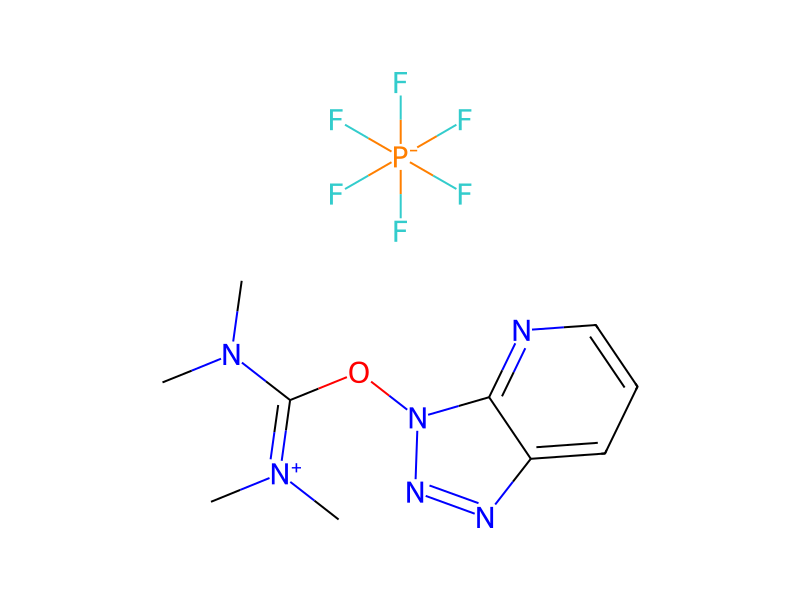 HCID 9886157Methanaminium, N-((dimethylamino)(3H-1,2,3-triazolo(4,5-b)pyridin-3-yloxy)methylene)-N-methyl-, hexafluorophosphate(1-) (1:1)
 HCID 668883222,2-Dimethyl-3-oxo-3-[3-(7H-pyrrolo[2,3-d]pyrimidin-4-yl)-3,8-diaza-bicyclo[3.2.1]oct-8-yl]-propionitrile
Product 1

Reagents, catalysts & solvents 1

Procedure
(intermediate 2) (0.05 mmol) was dissolved in dry DMF (0.3 mL). Triethylamine (0.18 mmol) and HATU (0.09 mmol) was added followed by 2-pyridincarboxylic acid (0.07 mmol). The reaction mixture was left at rt for 16 hours. The pure compounds were obtained by standard preparative HPLC purification of the reaction mixture.
Workup
- customThe pure compounds were obtained by standard preparative HPLC purification of the reaction mixture
Sources & evidence
- ORD record
- ord-61b67ac6a7ac4792b5748afe4127d130
- Source dataset
- uspto-grants-2016_05
- Patent number
- US09346809B2
Reaction notes
Loading…