Triphenylphosphine → 7-Cyclopropyl-2,4-dichloro-6,7-dihydro-[1,4]dioxino[2,3-d]pyrimidine
Reaction equation

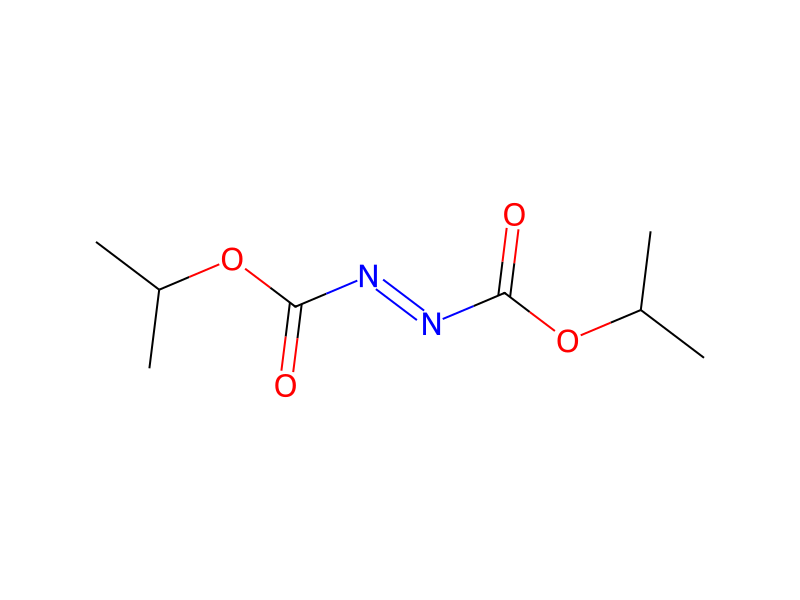
[Cl:1][C:2]1[N:7]=[C:6]([Cl:8])[C:5](O)=[C:4]([O:10][C:11]2([CH2:14][OH:15])[CH2:13][CH2:12]2)[N:3]=1.[C:16]1(P(C2C=CC=CC=2)C2C=CC=CC=2)C=CC=CC=1.CC(OC(/N=N/C(OC(C)C)=O)=O)C>C1COCC1>[CH:13]1([CH:11]2[O:10][C:4]3[N:3]=[C:2]([Cl:1])[N:7]=[C:6]([Cl:8])[C:5]=3[O:15][CH2:14]2)[CH2:12][CH2:16]1Participants
5
Reactant 3


Product 1

Reagents, catalysts & solvents 1

Procedure
To a solution of 2,4-dichloro-6-(1-hydroxymethyl-cyclopropoxy)-pyrimidin-5-ol (135 mg, 0.54 mmol) and triphenylphosphine (180 mg, 0.65 mmol) in THF (8 mL) was added DIAD (128 μL, 0.65 mmol) and the mixture stirred at RT for 30 minutes, then concentrated in vacuo. The resulting residue was purified by column chromatography (SiO2, gradient 0-25% ethyl acetate in cyclohexane) affording 7-Cyclopropyl-2,4-dichloro-6,7-dihydro-[1,4]dioxino[2,3-d]pyrimidine as a white solid (90 mg, 72%). 1H NMR (400 MHz, CDCl3): δ 4.30 (2H, s), 1.36-1.29 (2H, m), 1.01-0.95 (2H, m).
Workup
- concentrationconcentrated in vacuo
- customThe resulting residue was purified by column chromatography (SiO2, gradient 0-25% ethyl acetate in cyclohexane)
Sources & evidence
- ORD record
- ord-8600446a29054a17b8be197c6ff3e37a
- Source dataset
- uspto-grants-2016_05
- Patent number
- US09346817B2
Reaction notes
Loading…