Dichloromethane → HCID 15239200, compound
Reaction equation

[F:1][C:2](=[C:7]([F:9])[F:8])[CH2:3][C:4](Cl)=[O:5].[NH2:10][C:11]1[CH:12]=[C:13]([CH:17]=[CH:18][CH:19]=1)[C:14]([OH:16])=[O:15].C(=O)(O)[O-].[Na+].ClCCl>C(OCC)(=O)C.O>[F:1][C:2](=[C:7]([F:9])[F:8])[CH2:3][C:4]([NH:10][C:11]1[CH:12]=[C:13]([CH:17]=[CH:18][CH:19]=1)[C:14]([OH:16])=[O:15])=[O:5]Participants
7

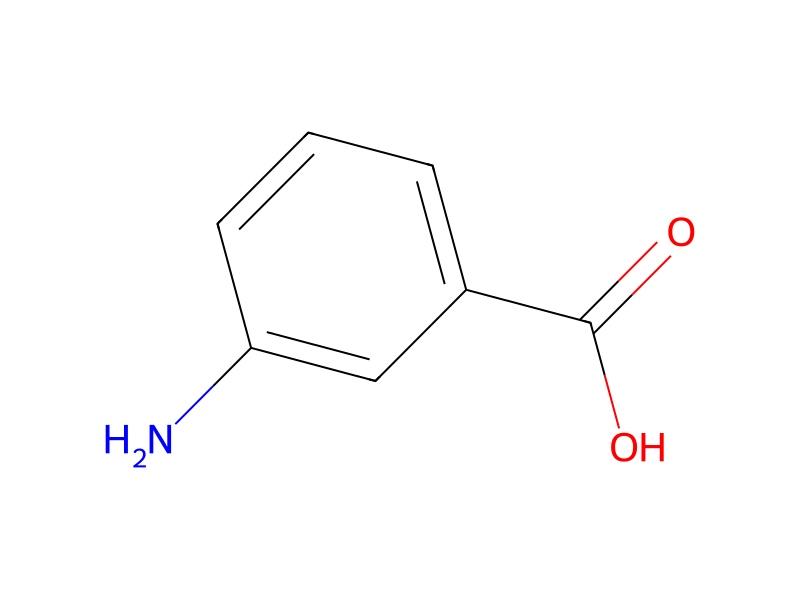





Conditions
- Temperature
- 0 °C
Procedure
2.2 g (0. 0139 mole) 3,4,4-trifluoro-3-butenoyl chloride is added to a mixture of 3-aminobenzoic acid (1.37 g, 0.01 mole), sodium bicarbonate (0.84 g, 0.01 mole), water (20 mL) and dichloromethane (20 mL) with stirring at 0° C. After stirring for 15 min at room temperature, the mixture is diluted with ethyl acetate (100 mL) and water (50 mL). The organic layer is washed with 2N HCl and brine, and dried. The residue obtained after evaporation of the solvent is triturated with dry ether and filtered to give 1.8 g of the title compound as a light pink solid, a 69% yield. m.p. 252°-255° C.
Workup
- stirringAfter stirring for 15 min at room temperature
- washThe organic layer is washed with 2N HCl and brine
- customdried
- customThe residue obtained
- customafter evaporation of the solvent
- customis triturated with dry ether
- filtrationfiltered
Sources & evidence
- ORD record
- ord-67c4e62d6a74486eb88b392254112728
- Source dataset
- uspto-grants-1997_04
- Patent number
- US05623084
Reaction notes
Loading…