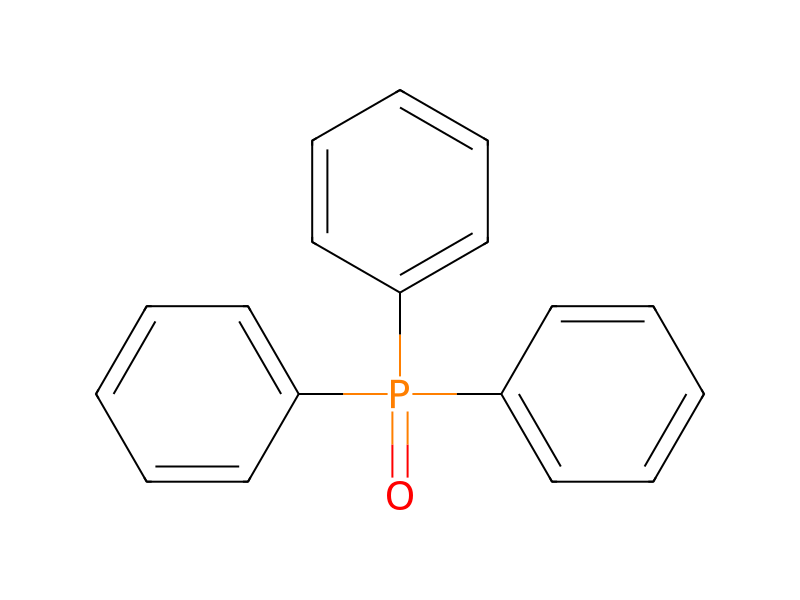
Triphenylphosphine → Triphenylphosphine Oxide
Reaction equation

ClC1N=CN=C2C=1N=CN2[C@H]1[C@@H]2[O:16]C(C)(C)O[C@@H]2[C@@H](CO)C1.C(NS(=O)=O)(OC(C)(C)C)=O.[C:34]1([P:40]([C:47]2[CH:52]=[CH:51][CH:50]=[CH:49][CH:48]=2)[C:41]2[CH:46]=[CH:45][CH:44]=[CH:43][CH:42]=2)[CH:39]=[CH:38][CH:37]=[CH:36][CH:35]=1.N(C(OC(C)C)=O)=NC(OC(C)C)=O>CCOC(C)=O>[C:47]1([P:40](=[O:16])([C:34]2[CH:35]=[CH:36][CH:37]=[CH:38][CH:39]=2)[C:41]2[CH:46]=[CH:45][CH:44]=[CH:43][CH:42]=2)[CH:48]=[CH:49][CH:50]=[CH:51][CH:52]=1Participants
6
Reactant 4




Product 1
Reagents, catalysts & solvents 1

Procedure
To a solution of ((3aR,4R,6R,6aS)-[6-(6-chloro-purin-9-yl)-2,2-dimethyltetrahydro-cyclopenta[1,3]dioxol-4-yl]-methanol (Yang, M.; Wei, Y.; Schneller, S. W. J. Org. Chem. 2004, 69, 3993-3996) (250.0 mg, 0.77 mmol), N-Boc-sulfonamide (226.6 mg, 1.16 mmol) and triphenylphosphine (242.3 mg, 0.92 mol) in EtOAc (8 mL) was added diisopropyl azodicarboxylate (227.3 μL, 1.16 mmol) dropwise as a solution in EtOAc (1 mL). The reaction was stirred at r.t. overnight, quenched with water and extracted with EtOAc. The organics were concentrated and the residue purified by flash chromatography (0 to 100% EtOAc/DCM) to obtain the product as an inseparable mixture with triphenylphosphine oxide. The material was carried on as such.
Workup
- customquenched with water
- extractionextracted with EtOAc
- concentrationThe organics were concentrated
- customthe residue purified by flash chromatography (0 to 100% EtOAc/DCM)
Sources & evidence
- ORD record
- ord-92f5bc84dbc246fb9bdcb1900addf900
- Source dataset
- uspto-grants-2011_05
- Patent number
- US07951810B2
Reaction notes
Loading…