Triphenylphosphine → 3-(Tridec-1-yn-1-yl)pyridine-4-carbaldehyde
Reaction equation

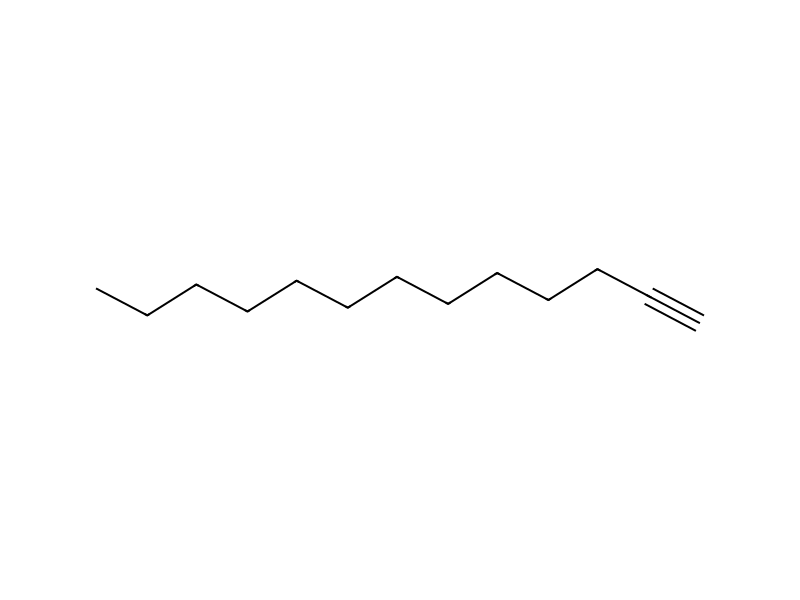
Br[C:2]1[CH:3]=[N:4][CH:5]=[CH:6][C:7]=1[CH:8]=[O:9].[CH:10]#[C:11][CH2:12][CH2:13][CH2:14][CH2:15][CH2:16][CH2:17][CH2:18][CH2:19][CH2:20][CH2:21][CH3:22].C1(P(C2C=CC=CC=2)C2C=CC=CC=2)C=CC=CC=1>C(N(CC)CC)C.C([O-])(=O)C.[Pd+2].C([O-])(=O)C>[C:10]([C:2]1[CH:3]=[N:4][CH:5]=[CH:6][C:7]=1[CH:8]=[O:9])#[C:11][CH2:12][CH2:13][CH2:14][CH2:15][CH2:16][CH2:17][CH2:18][CH2:19][CH2:20][CH2:21][CH3:22]Participants





Conditions
- Temperature
- 105 °C
Procedure
Palladium acetate (10.8 mg) was added to a stirred, deaerated solution of 3-bromopyridine-4-carboxaldehyde (0.80 g, 4.5 mmole; prepared as described by E. J. Corey, S. G. Pyne and A. I. Schafer, Tet. Letters, 3291, 1983), 1-tridecyne (1.4 g) and triphenylphosphine (36 mg) in anhydrous triethylamine (18 ml) maintained under an atmosphere of nitrogen. The mixture was stirred at 105° C. for 19 hours after which time it was cooled and the precipitated triethylamine hydrobromide filtered off. Chromatography of the evaporated filtrate on silica using dichloromethane as eluant afforded 0.93 g (73%) of the title compound as a white crystalline solid of mp (petroleum ether [bp. 40°-60° C.]) 38°-39° C., νmax (mull) 2230, 1710 cm-1 ; δ(CDCl3) 0.87 (3H, distorted t, terminal CH3), 1.12-1.76 (18H, m, alkylene chain), 2.48 (2H, t, J 6 Hz, CH2 --C≡C), 7.62 (1H, d, J 5 Hz, C-5H), 8.63 (1H, d, J 5 Hz, C-6H), 8.82 (1H, s, C-2H), 10.52 (1H, s, aldehyde C-H).
Workup
- customprepared
- temperaturewas cooled
- filtrationthe precipitated triethylamine hydrobromide filtered off
Sources & evidence
- ORD record
- ord-685f2d61f2854d31b4fcc0aa67cd155c
- Source dataset
- uspto-grants-1988_03
- Patent number
- US04732901
Reaction notes
Loading…