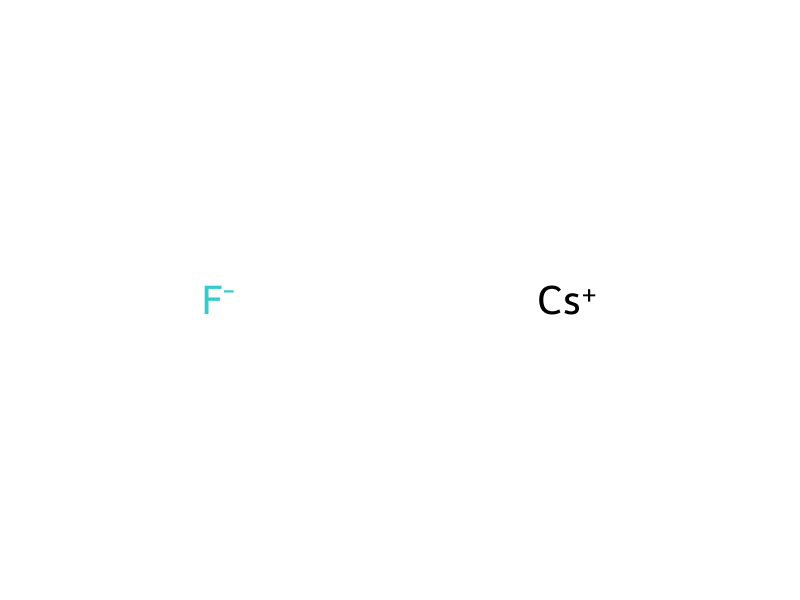
Cesium fluoride → methyl 2-(4-(1-(4-(trifluoromethoxy)phenyl)-1H-1,2,4-triazol-3-yl)phenyl)acetate
Reaktionsgleichung

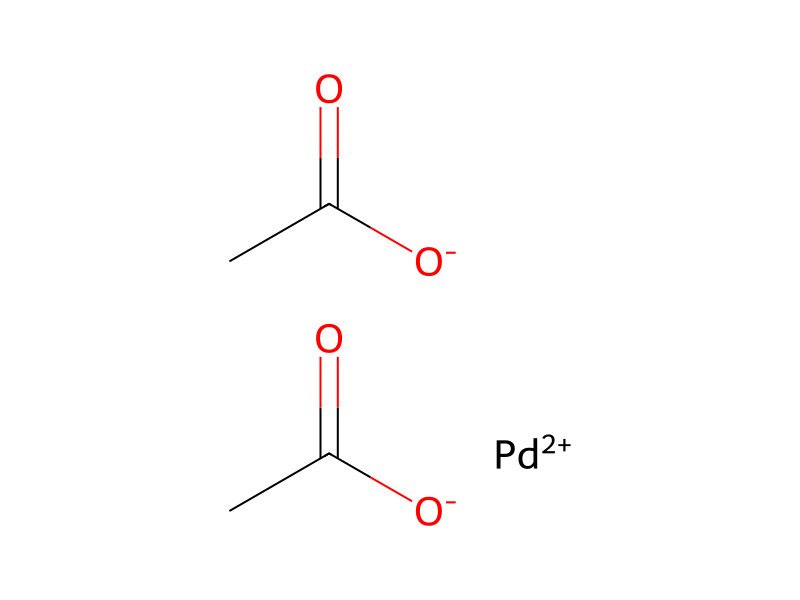
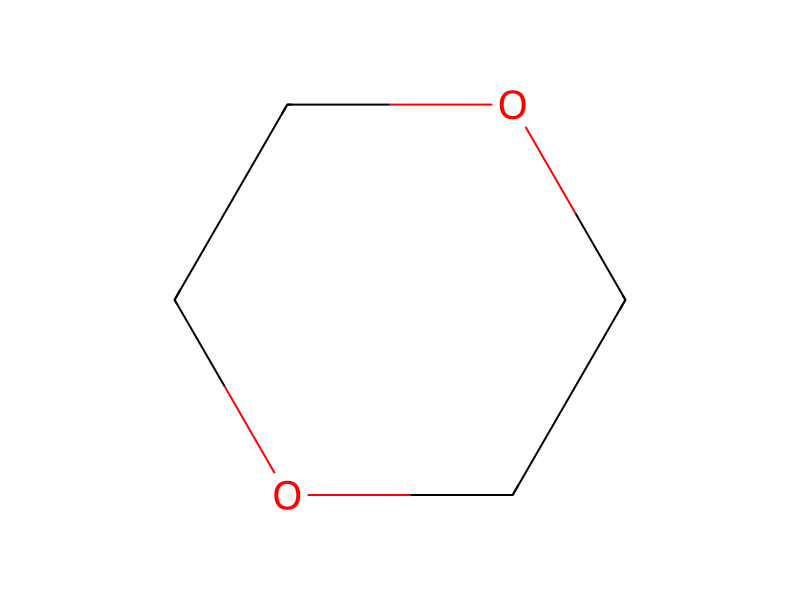
Br[C:2]1[N:6]=[CH:5][N:4]([C:7]2[CH:12]=[CH:11][C:10]([O:13][C:14]([F:17])([F:16])[F:15])=[CH:9][CH:8]=2)[N:3]=1.CC1(C)C(C)(C)OB([C:26]2[CH:31]=[CH:30][C:29]([CH2:32][C:33]([O:35][CH3:36])=[O:34])=[CH:28][CH:27]=2)O1.F[B-](F)(F)F.C([PH+](C(C)(C)C)C(C)(C)C)(C)(C)C.[F-].[Cs+]>O1CCOCC1.O.[Cl-].[Na+].O.C([O-])(=O)C.[Pd+2].C([O-])(=O)C>[F:15][C:14]([F:17])([F:16])[O:13][C:10]1[CH:11]=[CH:12][C:7]([N:4]2[CH:5]=[N:6][C:2]([C:26]3[CH:31]=[CH:30][C:29]([CH2:32][C:33]([O:35][CH3:36])=[O:34])=[CH:28][CH:27]=3)=[N:3]2)=[CH:8][CH:9]=1Komponenten
Edukt 4


Produkt 1

Reagenzien, Katalysatoren, Lösungsmittel 4

Reaktionsbedingungen
- Temperatur
- 60 °C
Versuchsvorschrift
To a 200 mL round bottomed flask equipped with a magnetic stir bar was added 3-bromo-1-(4-(trifluoromethoxy)phenyl)-1H-1,2,4-triazole (C1) (3.45 g, 11.2 mmol), and methyl 2-(4-(4,4,5,5-tetramethyl-1,3,2-dioxaborolan-2-yl)phenyl)acetate (C2) (3.71 g, 13.4 mmol). These reagents were diluted with dioxane (45.0 mL) and water (11.3 mL) and the resulting solution was sparged with nitrogen gas for 10 minutes. Tri-tert-butylphosphonium tetrafluoroborate (0.325 g, 1.12 mmol), palladium(II) acetate (0.126 g, 0.560 mmol) and cesium fluoride (3.40 g, 22.4 mmol) were added as solids. The flask was sealed and placed under nitrogen atmosphere. The reaction mixture was heated to an internal temperature of 60° C. The reaction mixture was allowed to cool to room temperature, and was poured into a brine solution and the layers were partitioned. The aqueous phase was extracted with ethyl acetate (3×100 mL). The combined organic layers were dried over anhydrous magnesium sulfate, filtered, and concentrated. The resulting residue was purified via flash column chromatography using 0-10% ethyl acetate/hexanes as eluent to afford the title compound as an off-white solid (3.45 g, 82%): 1H NMR (400 MHz, DMSO-d6) δ 9.41 (s, 1H), 8.11-8.04 (m, 4H), 7.63 (ddt, J=7.9, 2.1, 1.1 Hz, 2H), 7.48-7.36 (m, 2H), 3.77 (s, 2H), 3.64 (s, 3H); 19F NMR (376 MHz, DMSO-d6) δ −57.02; ESIMS m/z 378 ([M+H]+).
Aufarbeitung
- customTo a 200 mL round bottomed flask equipped with a magnetic stir bar
- customthe resulting solution was sparged with nitrogen gas for 10 minutes
- customThe flask was sealed
- temperatureto cool to room temperature
- customthe layers were partitioned
- extractionThe aqueous phase was extracted with ethyl acetate (3×100 mL)
- dry with materialThe combined organic layers were dried over anhydrous magnesium sulfate
- filtrationfiltered
- concentrationconcentrated
- customThe resulting residue was purified via flash column chromatography
Quellen und Nachweise
- ORD-Eintrag
- ord-0eb8826562034595964caa77c9005ab2
- Quelldatensatz
- uspto-grants-2015_05
- Patentnummer
- US09029560B2
Notizen zur Reaktion
Wird geladen…