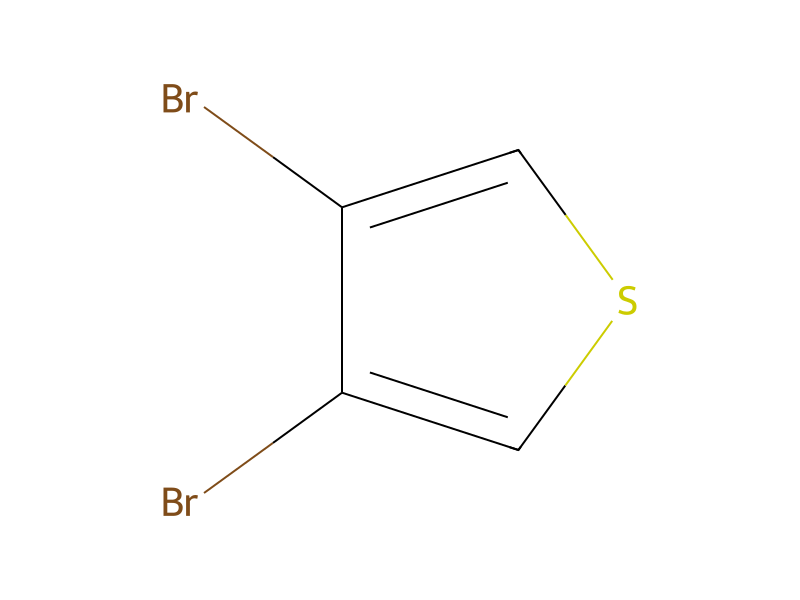
3,4-Dibromothiophene → 3-Bromo-4-(2-fluoropyridin-3-yl)thiophene
Reaction equation

[F:1][C:2]1[C:7]([Sn](CCCC)(CCCC)CCCC)=[CH:6][CH:5]=[CH:4][N:3]=1.[Br:21][C:22]1[C:26](Br)=[CH:25][S:24][CH:23]=1.[F-].[K+]>CN1CCCC1=O.C(OCC)(=O)C.Cl[Pd](Cl)([P](C1C=CC=CC=1)(C1C=CC=CC=1)C1C=CC=CC=1)[P](C1C=CC=CC=1)(C1C=CC=CC=1)C1C=CC=CC=1>[Br:21][C:22]1[C:26]([C:7]2[C:2]([F:1])=[N:3][CH:4]=[CH:5][CH:6]=2)=[CH:25][S:24][CH:23]=1Participants
7
Reactant 3


Product 1

Reagents, catalysts & solvents 3



Conditions
- Temperature
- 100 °C
Procedure
A mixture of 2-fluoro-3-tributylstannylpyridine (1.9 g), 3, 4-dibromothiophene (1.5 g) and Pd(Ph3P)2Cl2 (0.175 g) in N-methylpyrrolidinone (7.5 mL), in a sealed tube, was heated at 100° C. for 16 hours. The mixture was cooled and stirred with aqueous potassium fluoride for 6 hours. The mixture was diluted with ethyl acetate, washed with water, dried filtered and evaporated. The residue was fractionated by chromatography to give 3-bromo-4-(2-fluoropyridin-3-yl)thiophene (0.35 g), mp 48-50° C.
Workup
- temperatureThe mixture was cooled
- washwashed with water
- customdried
- filtrationfiltered
- customevaporated
Sources & evidence
- ORD record
- ord-83eae3fdba584131b316cfdaea36b509
- Source dataset
- uspto-grants-1999_07
- Patent number
- US05919779
Reaction notes
Loading…