Hydrochloric Acid → Benzyl piperazine-1-carboxylate
Reaction equation

O.O.O.O.O.O.[NH:7]1[CH2:12][CH2:11][NH:10][CH2:9][CH2:8]1.Cl.Cl[C:15]([O:17][CH2:18][C:19]1[CH:24]=[CH:23][CH:22]=[CH:21][CH:20]=1)=[O:16].[OH-].[Na+]>CO.O>[N:7]1([C:15]([O:17][CH2:18][C:19]2[CH:24]=[CH:23][CH:22]=[CH:21][CH:20]=2)=[O:16])[CH2:12][CH2:11][NH:10][CH2:9][CH2:8]1Participants
Reactant 4




Product 1
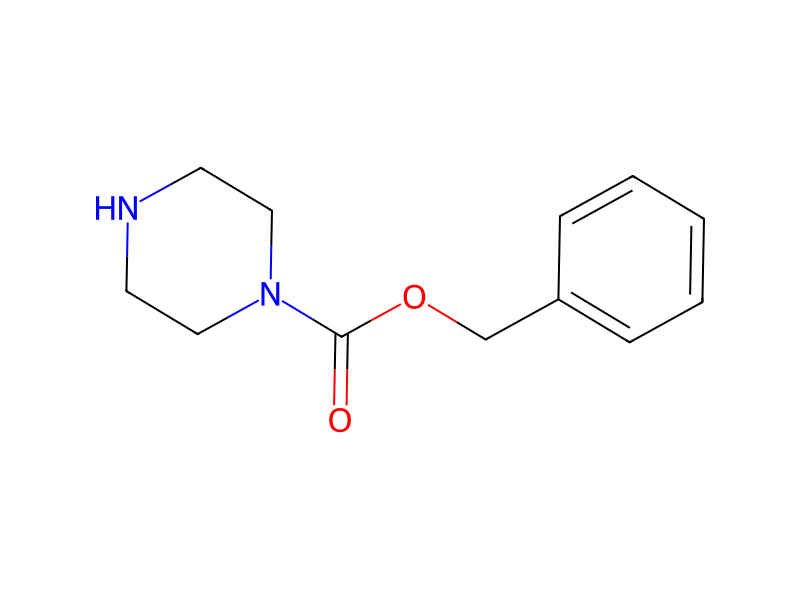
Reagents, catalysts & solvents 2


Conditions
- Temperature
- 25 °C
Procedure
250 ml of water and 500 ml of methanol are added to 194 g (1 M) of piperazine hexahydrate, while stirring, and the pH is adjusted to 3 with about 163 ml of concentrated hydrochloric acid. The mixture is then cooled to 25° C. and 100 g (0.59 M) of benzyl chloroformate are added dropwise, while stirring, during which the pH is kept between 3 and 4.5 with sodium hydroxide solution (4 M; about 230 ml). About 700 ml are then stripped off on a rotary evaporator and the residue is washed with water, rendered acid with about 1.5 ml of concentrated HCl and extracted twice with 200 ml of toluene each time. The aqueous phase is cooled and brought to pH 12 with about 115 ml of 12.5 N NaOH. The oil which separates out is extracted several times with toluene, and the extract is dried over K2CO3 and concentrated under reduced pressure. Yield: 74 g
Workup
- stirringwhile stirring, during which the pH
- customAbout 700 ml are then stripped off on a rotary evaporator
- washthe residue is washed with water
- extractionextracted twice with 200 ml of toluene each time
- temperatureThe aqueous phase is cooled
- extractionThe oil which separates out is extracted several times with toluene
- dry with materialthe extract is dried over K2CO3
- concentrationconcentrated under reduced pressure
Sources & evidence
- ORD record
- ord-029b1fca856c42289fc74bc3a5640b98
- Source dataset
- uspto-grants-1999_07
- Patent number
- US05922868
Reaction notes
Loading…