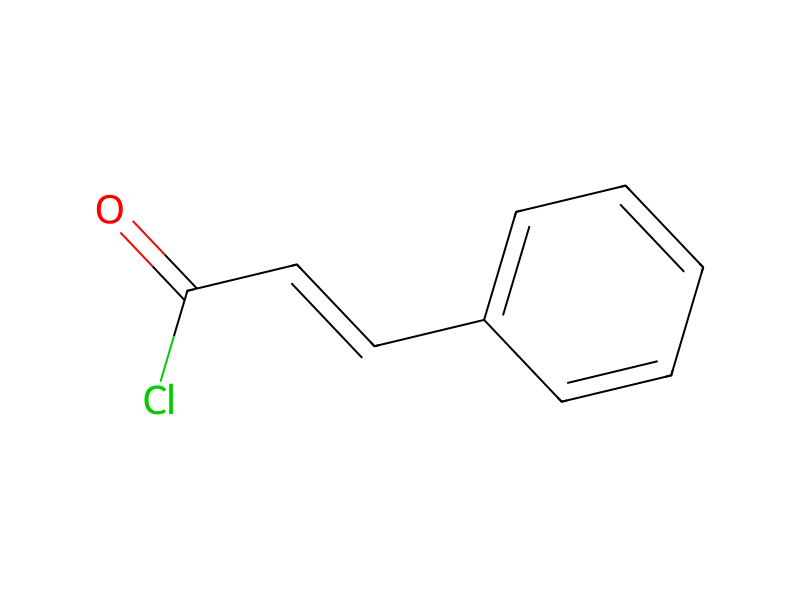
Benzaldehyde → 3-Phenylprop-2-enoyl chloride
Reaction equation

[C:1]([OH:11])(=O)[CH:2]=[CH:3][C:4]1[CH:9]=[CH:8][CH:7]=[CH:6][CH:5]=1.C(=O)C1C=CC=CC=1.C(O)(=O)CC(O)=O.S(Cl)([Cl:29])=O>N1C=CC=CC=1.N1CCCCC1>[C:1]([Cl:29])(=[O:11])[CH:2]=[CH:3][C:4]1[CH:9]=[CH:8][CH:7]=[CH:6][CH:5]=1Participants
7
Reactant 4



Product 1
Reagents, catalysts & solvents 2


Procedure
A cinnamic acid is first prepared by reacting a benzaldehyde with malonic acid in pyridine and piperidine. The cinnamic acid is then reacted with thionyl chloride to produce a cinnamoyl chloride derivative. The HE-CelCN is finally synthesized by reacting HE-cellulose with the cinnamoyl chloride derivative in an inert solvent (such as chloroform, nitrobenzene, chlorobenzene, or the like). The reaction mixture is diluted with methanol, filtered, dried in a vacuum, and milled by a vibrating mill, whereupon the CelCN is obtained.
Sources & evidence
- ORD record
- ord-6af16b238ab049ccb5fea362f05c1753
- Source dataset
- uspto-grants-2011_03
- Patent number
- US07901605B2
Reaction notes
Loading…