Sodium hydride → Methyl 1-cyclobutyl-1H-indazole-3-carboxylate
Reaction equation

[H-].[Na+].[NH:3]1[C:11]2[C:6](=[CH:7][CH:8]=[CH:9][CH:10]=2)[C:5]([C:12]([O:14][CH3:15])=[O:13])=[N:4]1.Br[CH:17]1[CH2:20][CH2:19][CH2:18]1.C(=O)([O-])O.[Na+]>CN(C)C=O>[CH:17]1([N:3]2[C:11]3[C:6](=[CH:7][CH:8]=[CH:9][CH:10]=3)[C:5]([C:12]([O:14][CH3:15])=[O:13])=[N:4]2)[CH2:20][CH2:19][CH2:18]1Participants



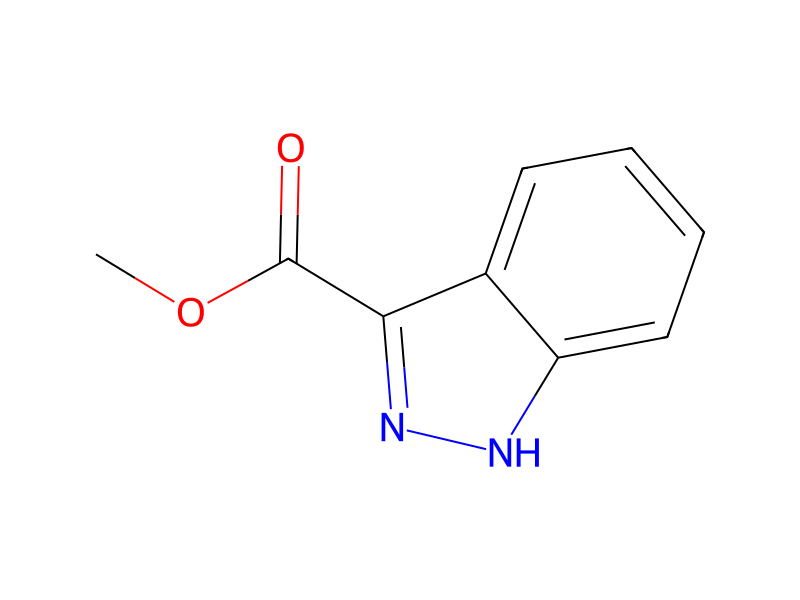


Procedure
To a suspension of sodium hydride (60% in mineral, 817 mg, 20.4 mmol) in N,N-dimethylformamide (30 mL) was added a solution of methyl 1H-indazole-3-carboxylate in N,N-dimethylformamide (20 mL) at room temperature. After stirring for 30 min, bromocyclobutane (3.45 g, 25.5 mmol) was added, and the mixture was stirred at 90° C. for 13 h. After cooling to room temperature, the mixture was poured onto saturated aqueous sodium hydrogencarbonate solution (200 mL), and the aqueous layer was extracted with ethyl acetate/toluene (3:1, 200 mL×2). The combined organic layer was dried over magnesium sulfate, and concentrated under reduced pressure. The residue was chromatographed on a column of silica gel eluting with ethyl acetate/n-hexane (1:6 then 1:5) to give 2.21 g (56%) of the title compound as a colorless oil.
Workup
- stirringthe mixture was stirred at 90° C. for 13 h
- extractionthe aqueous layer was extracted with ethyl acetate/toluene (3:1, 200 mL×2)
- dry with materialThe combined organic layer was dried over magnesium sulfate
- concentrationconcentrated under reduced pressure
- customThe residue was chromatographed on a column of silica gel eluting with ethyl acetate/n-hexane (1:6
Sources & evidence
- ORD record
- ord-fdaf70fe5bff45d8aff3fac391713880
- Source dataset
- uspto-grants-2011_03
- Patent number
- US07906532B2
Reaction notes
Loading…