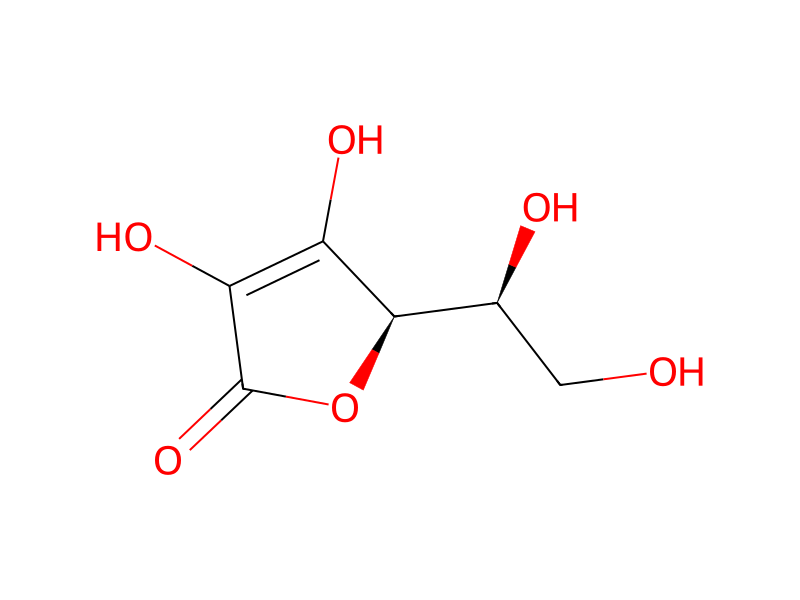
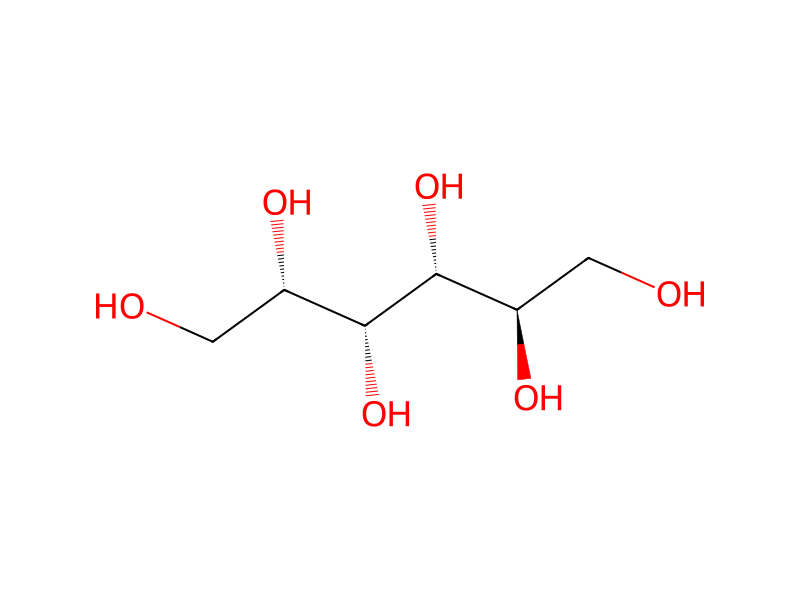
(2R,3S,4R,5R)-2,3,4,5,6-pentahydroxyhexanal → Sorbitol
Reaction equation

[O:1]=[C:2]1[O:8][C@H:7]([C@H:9]([CH2:11][OH:12])[OH:10])[C:5]([OH:6])=[C:3]1[OH:4].[O:13]=[CH:14][C@@H:15]([C@H:17]([C@@H:19]([C@@H:21]([CH2:23][OH:24])[OH:22])[OH:20])[OH:18])[OH:16]>>[OH:12][CH2:11][C@@H:9]([C@H:7]([C@@H:5]([C@@H:3]([CH2:2][OH:1])[OH:4])[OH:6])[OH:8])[OH:10].[O:13]=[CH:14][C@@H:15]([C@H:17]([C@@H:19]([C@@H:21]([CH2:23][OH:24])[OH:22])[OH:20])[OH:18])[OH:16]Participants
4

Procedure
The results reported in Table 3 demonstrate that ascorbic acid can be synthesized from glucose in one step. This is very advantageous in that using D-glucose instead of D-sorbitol as the starting material in the synthesis of vitamin-C eliminates the hydrogenation step, and its associated costs, necessary to produce D-sorbitol from D-glucose.
Sources & evidence
- ORD record
- ord-4692b62738584436ac2777445bbfe857
- Source dataset
- uspto-grants-1999_12
- Patent number
- US05998634
Reaction notes
Loading…