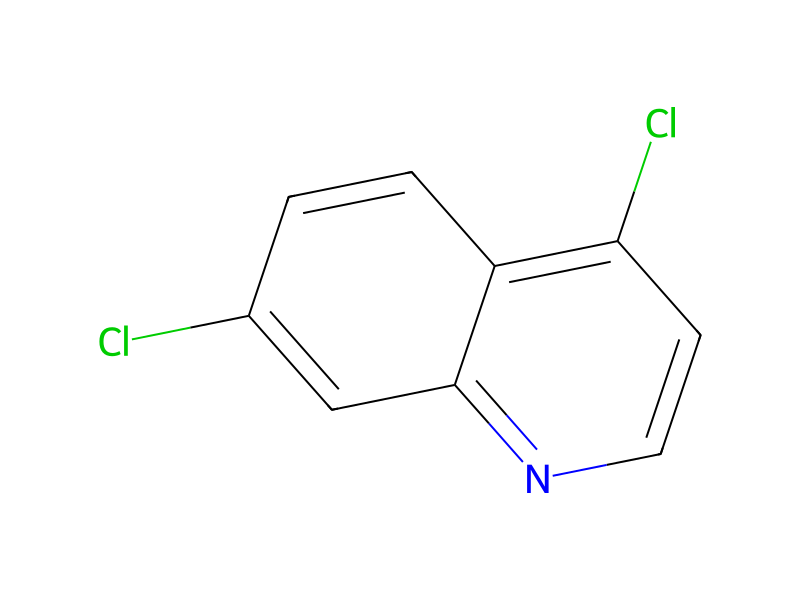
4,7-Dichloroquinoline → HCID 57227818, compound
Reaction equation

[NH2:1][C@H:2]1[CH2:7][CH2:6][CH2:5][CH2:4][C@@H:3]1[NH2:8].Cl[C:10]1[C:19]2[C:14](=[CH:15][C:16]([Cl:20])=[CH:17][CH:18]=2)[N:13]=[CH:12][CH:11]=1.C(N(CC)CC)C>CN1CCCC1=O>[Cl:20][C:16]1[CH:15]=[C:14]2[C:19]([C:10]([NH:1][C@H:2]3[CH2:7][CH2:6][CH2:5][CH2:4][C@@H:3]3[NH2:8])=[CH:11][CH:12]=[N:13]2)=[CH:18][CH:17]=1Participants
Reactant 3


Product 1

Reagents, catalysts & solvents 1

Procedure
13.6 g of (1S,2S)-(+)-1,2-diaminocyclohexane, 23.6 g of 4,7-dichloroquinoline and 16.6 ml of triethylamine were held at 150° C. in 150 ml of 1-methyl-2-pyrrolidone under argon for 16 hrs. The solvent was largely distilled off at 0.1 Torr/80° C. and the residue was triturated with 300 ml of 1.5N HCl. The resulting aqueous suspension was extracted three times with 300 ml of dichloromethane and then made basic with concentrated ammonia, with gum-like clumps separating. The supernatant solution was decanted off and extracted twice with 400 ml of dichloromethane. The crude product obtained from these extracts was purified by two-fold flash chromatography on neutral aluminium oxide (Brockmann activity II) with dichloromethane and dichloromethane/ethanol 30:1. Crystallization was effected from 40 ml of dichloromethane and 60 ml of ethyl acetate by distillation of the former. Yield: 4 g (12%) of (1S,2S)-N-(7-chloro-quinolin-4-yl)-cyclohexane-1,2-diamine; m.p. 160° C., [α]D =+129.30 (MeOH, c=1.0).
Workup
- distillationThe solvent was largely distilled off at 0.1 Torr/80° C.
- customthe residue was triturated with 300 ml of 1.5N HCl
- extractionThe resulting aqueous suspension was extracted three times with 300 ml of dichloromethane
- customseparating
- customThe supernatant solution was decanted off
- extractionextracted twice with 400 ml of dichloromethane
Sources & evidence
- ORD record
- ord-768e3b8830834c3eb4d2250a8a53e7bf
- Source dataset
- uspto-grants-1999_09
- Patent number
- US05948791
Reaction notes
Loading…