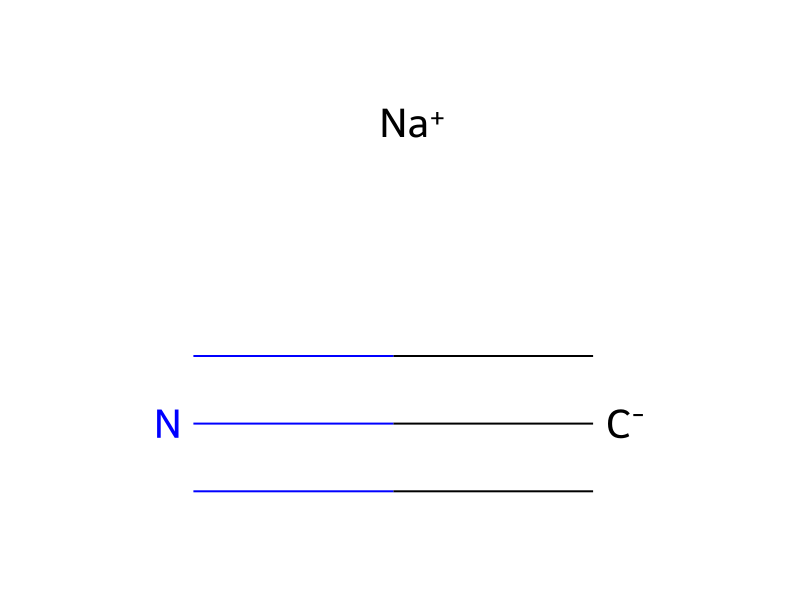
Sodium Cyanide → Isoquinoline-5-carbonitrile
Reaction equation

N[C:2]1[CH:11]=[CH:10][CH:9]=[C:8]2[C:3]=1[CH:4]=[CH:5][N:6]=[CH:7]2.N([O-])=O.[Na+].C(=O)(O)[O-].[Na+].[I-].[C-]#N.[Na+].[Cu](C#N)[C:26]#[N:27]>Cl.O.C(OCC)(=O)C.C1(C)C=CC=CC=1>[C:26]([C:2]1[CH:11]=[CH:10][CH:9]=[C:8]2[C:3]=1[CH:4]=[CH:5][N:6]=[CH:7]2)#[N:27]Participants
Reactant 6





Product 1

Reagents, catalysts & solvents 4




Procedure
To a cold (0° C.) solution of 10.0 g (61.4 mmol) of 5-aminoisoquinoline in 288 mL of 1.5N hydrochloric acid, was added 15 mL of 5.2M sodium nitrite in water. After approximately 5 minutes, a cool saturated solution of sodium bicarbonate was added to the reaction mixture until the reaction solution tested negative using the iodide and start paper test. The resultant solution was poured into a cold (0-5° C.) biphasic mixture containing 300 ml of toluene and 150 mL of an aqueous solution containing 8.4 g (177 mmol) of sodium cyanide and 7.6 g (85 mmol) of copper cyanide. The resultant reaction mixture was warmed to room temperature, reacted for approximately 1 hour, and then diluted with a mixture of ethyl acetate and water. The resulting layers were separated, and the organic phase was dried over sodium sulfate, filtered, and then reduced to dryness under reduced pressure to provide 5.9 g of a yellow solid.
Workup
- customThe resultant reaction mixture
- customreacted for approximately 1 hour
- customThe resulting layers were separated
- dry with materialthe organic phase was dried over sodium sulfate
- filtrationfiltered
Sources & evidence
- ORD record
- ord-11b8017b551d4de6be6f4bbb932f038a
- Source dataset
- uspto-grants-1999_09
- Patent number
- US05952343
Reaction notes
Loading…